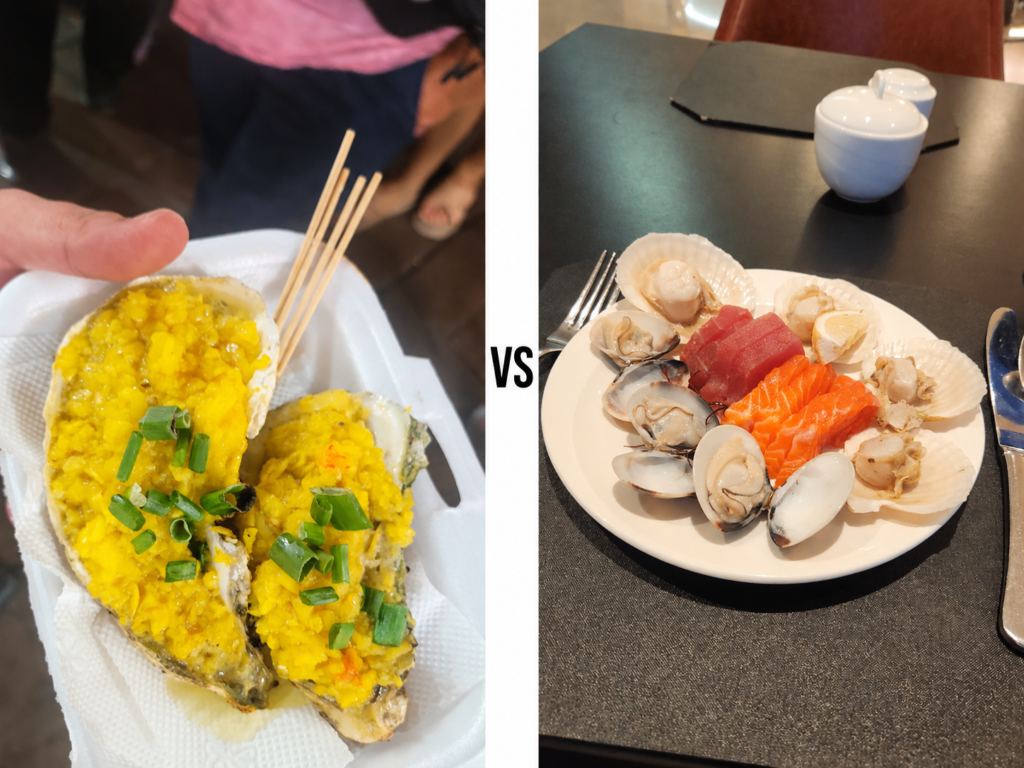
A rainy evening, RM80 of street food, a suspicious Ritz-Carlton discount, and an unnecessarily thorough due-diligence exercise on dinner.
A rainy evening, RM80 of street food, a suspicious Ritz-Carlton discount, and an unnecessarily thorough due-diligence exercise on dinner.
By Boo Kok Chuon
I arrived in Kuala Lumpur a little earlier than my client today. Since I had some time to myself, I decided to do something unusually unproductive and hunt down some local food. It was raining, but I was already around Bukit Bintang, so Jalan Alor seemed like the obvious place to start. My objective was actually quite specific: I wanted oysters.
So there I was, holding an umbrella, walking slowly down Jalan Alor and comparing seafood stalls like some slightly deranged procurement officer. The prices looked perfectly reasonable: two oysters for RM10, four half-shell scallops for RM15, and chicken for about RM10 a portion. Nothing alarming there. But I wanted more than two oysters, so the mental calculator started running.
Three portions of oysters would be RM30.
Two portions of scallops, another RM30.
Perhaps two portions of chicken, RM20.
Total: RM80.
I stopped.
Now this was interesting.
The Valuer-Accountant Smelled a Rat
There was nothing objectively wrong with RM80. It was simply that, once the intended basket reached RM80, the valuer-accountant in me started wondering whether the apparent cheapness of the individual items had survived aggregation. RM10 sounded cheap. RM15 sounded cheap. But I was not buying a RM10 oyster dish; I was buying dinner, and dinner was beginning to cost RM80.
This triggered what I can only describe as my internal pricing-risk protocol. The food was not expensive. The portfolio was. So I pulled out Eatigo.
Ten minutes’ walk away, The Ritz-Carlton Kuala Lumpur had a dinner buffet at The Cobalt Room.
Normal price:
RM170++.
Eatigo price for the 6.30pm slot:
50% off.
That brought the buffet down to RM85 before service charge and tax.
I stared at the screen.
RM80 at Jalan Alor.
RM85 at The Ritz-Carlton.
I looked back at the oysters.
I looked back at my phone.
Something was wrong with this picture.
Or perhaps something was very right.
Naturally, I Conducted Due Diligence on Dinner
Then I converted RM85 into Singapore dollars: roughly S$28. S$28 for dinner at The Ritz-Carlton. You cannot always get a decent mookata buffet at a neighbourhood kopitiam in Singapore for S$28, yet here I was being offered a Ritz-Carlton buffet for about the same money. At this point, the deal had crossed from “interesting” into “suspicious”. When a deal looks too good to be true, the forensic economist in me demands an explanation.
So I did what any perfectly normal person standing under an umbrella in Bukit Bintang would do: I asked my ChatGPT buddy to conduct real-time transactional due diligence on my dinner reservation.
We perused the Eatigo terms, read together with the Malaysian Interpretation Acts 1948 and 1967 (Act 388), looking for any hidden draconian provisions. We checked whether the restaurant’s buffet offering carried additional conditions, whether the 50% discount actually applied to the buffet itself, whether service charges and taxes were excluded, whether drinks were covered, and whether there were any hidden minimum-spend requirements. And because apparently none of this was excessive enough, we conducted a small empirical inquiry by sampling recent diner reports to see what people had actually paid.
At this point, I had spent more intellectual effort verifying dinner than some people spend reading a tenancy agreement.
Eatigo’s own listing confirmed that the Ritzy Weekend Feast was ordinarily priced at RM170 and could be discounted to RM85. It also stated that prices were exclusive of tax and service charge unless otherwise indicated.
One recent diner even reported paying RM197 for two persons after the 50% discount.
That was reassuringly close to what the arithmetic predicted.
The deal appeared genuine. No mysterious minimum spend, no hidden compulsory bottle of champagne, and no contractual clause requiring me to surrender my firstborn before dessert.
So I booked it.
My final bill:
RM98.60 nett.
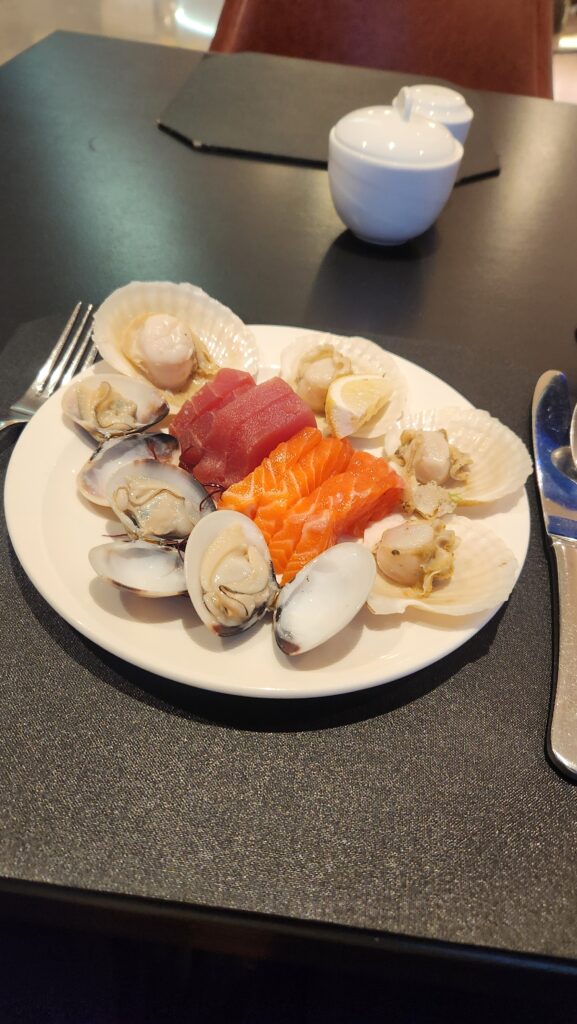
At that point, my casual dinner had turned into a microeconomics experiment.
Why Would the Ritz Sell a RM170 Buffet for RM85?
When I arrived, the first thing I noticed was how quiet the restaurant was. The buffet was already laid out: the sashimi was there, the scallops were there, and the roast lamb was there.
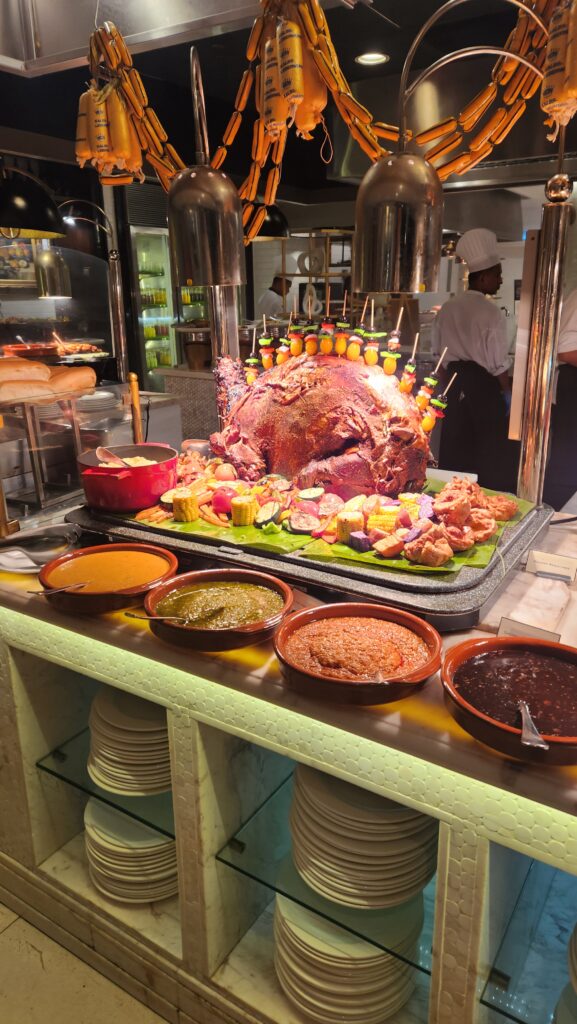
There were trays of hot food, seafood, desserts and juices waiting patiently for customers who had apparently not received the memo.
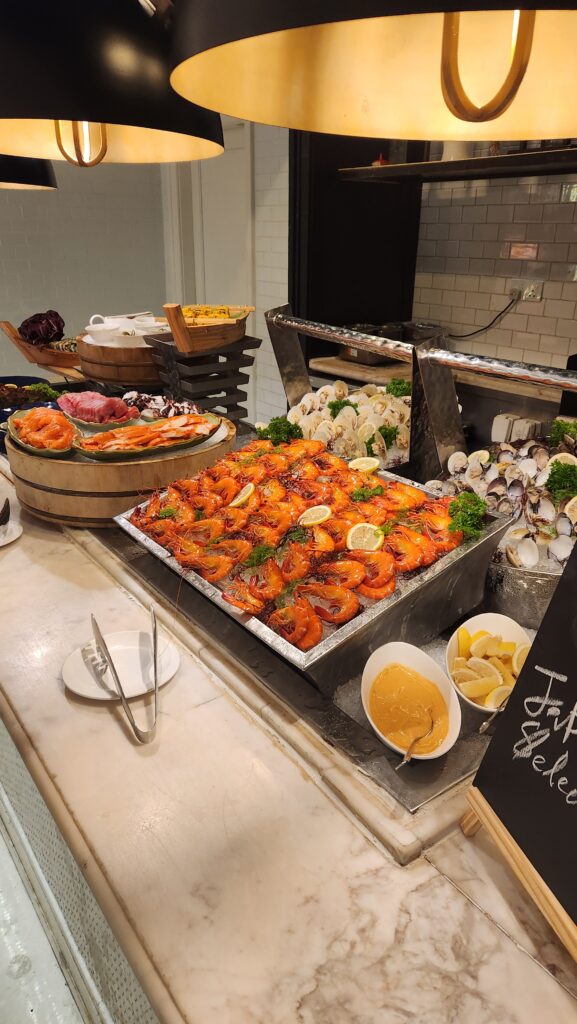
And suddenly the economics became rather obvious.
By that point in the evening, much of the cost of running the buffet had already been committed. The chefs were already at work, the food had already been purchased and prepared, the roast lamb was already roasting, the sashimi had already been sliced, the service staff were already there, and the dining room was already lit. There was, as I later discovered, even a live band.
Whether I walked into the restaurant or remained outside eating oysters in the rain, much of that cost was not going away. But an empty restaurant seat has one particularly inconvenient characteristic: it cannot be stored. If a table remains empty during tonight’s dinner service, the Ritz cannot put that unused 6.30pm capacity into a refrigerator and sell it tomorrow.
In revenue-management literature, this is the problem of perishable capacity.
Cornell hospitality scholar Sheryl Kimes has written extensively on restaurant revenue management, particularly where businesses operate with relatively fixed capacity, perishable inventory, high fixed costs relative to variable costs, fluctuating demand and customers with different price sensitivities. Her discussion of strategic pricing through revenue management fits restaurants rather neatly.
So perhaps the hotel’s relevant question at 6pm was no longer:
Can we sell this dinner for RM170?
It may instead have been:
If this table is otherwise going to remain empty, would we rather earn RM85 from it or RM0?
Suddenly, 50% off does not look like charity.
It looks like inventory management.
Very tasty inventory management.
This Is Where Price Discrimination Gets Delicious
Of course, The Ritz-Carlton cannot simply hang a banner outside saying:
BUFFET RM85 EVERY NIGHT.
If everyone knew that RM170 reliably became RM85, the RM170 price would have a rather short and unhappy life. Instead, Eatigo creates what economists would recognise as a form of segmented, time-based pricing: the hotel preserves its headline price, while a price-sensitive customer willing to search for a particular time slot can access another price.
Eatigo itself describes its model as offering time-based discounts of up to 50% off the food bill. Restaurant revenue-management literature has long examined the same basic idea: shift price-sensitive customers towards periods when capacity would otherwise be underutilised.
That distinction matters because I was never really a lost RM170 customer. I would not have eaten at The Ritz-Carlton that evening for RM170++; at that price, I would have happily continued down Jalan Alor and prosecuted my oyster strategy. So the hotel’s choice was not necessarily:
RM170 from KC
versus
RM85 from KC.
For a marginal customer like me, it looked more like:
RM0 from KC
versus
RM85 from KC.
Suddenly the 50% discount looks positively sensible.
Their mistake, if any, was allowing the RM85 customer to arrive with a strong preference for slipper lobster.
Jalan Alor Accidentally Became Ritz-Carlton’s Competitor
This was the part I found particularly amusing. I doubt the seafood stalls at Jalan Alor consider The Ritz-Carlton Kuala Lumpur their direct competitor, and I equally doubt anyone in The Ritz-Carlton’s revenue-management department spends much time worrying about the price of half-shell scallops being sold ten minutes away. But for several minutes that evening, they were competing directly for my dinner budget, because substitution ultimately occurs in the mind of the consumer.
My choice was not between:
Ritz-Carlton at RM170 and Ritz-Carlton at RM85.
My actual choice was:
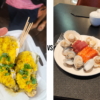
Jalan Alor dinner at approximately RM80, or Ritz-Carlton buffet at RM85 before charges.
A time-based discount had compressed two products that normally occupy completely different market positions into almost the same price range.
And once that happened, things became slightly ridiculous.
For an additional RM18.60 nett, roughly S$6, over the street-food basket I had originally contemplated, I moved ten minutes down the road into a five-star hotel.
By the end of dinner, I had consumed, among other things:
- four pieces of slipper lobster;
- ten scallops;
- three mussels;
- four reasonably large clams;
- eight thick cuts of salmon sashimi;
- nine thick cuts of tuna sashimi;
- roast lamb which was ridiculously good;
- seafood paella;
- satay;
- two servings of lobster noodles;
- durian puffs and puddings;
- four bottles of apple juice; and
- one bottle of orange juice.
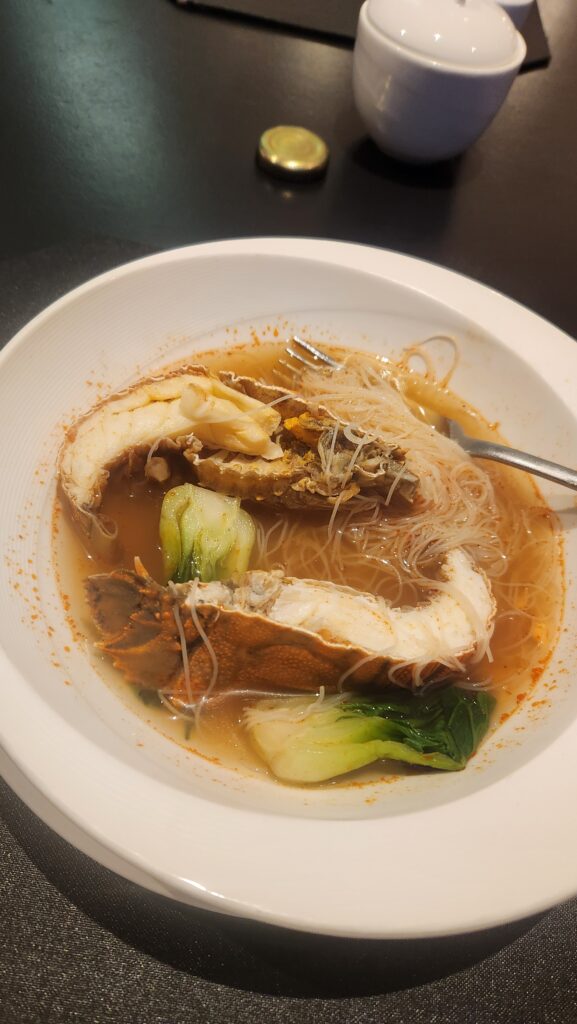
The sashimi was extremely fresh.
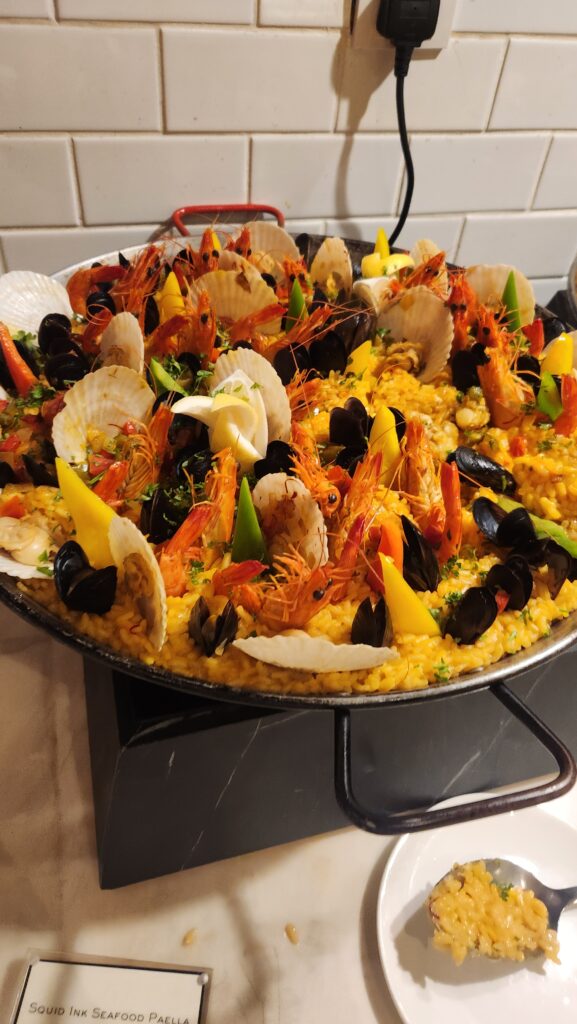
The roast lamb alone almost justified the evening.

There was also a live band.
I did not touch the prawns.
They were too common.
There are limits to diversification.
Cheap Is Not the Same Thing as Good Value
This little episode also illustrates something that tends to get lost whenever we describe things simply as “cheap” or “expensive”. Jalan Alor was cheap. The Ritz-Carlton was expensive. Both statements are intuitively true, yet neither was particularly useful for the decision I was actually making.
Economics is not concerned with maximising cheapness. If it were, the optimal dinner would presumably be tap water followed by sleep. The more interesting question is what additional utility I obtain from each additional unit of expenditure.
My incremental cost was RM18.60. For that RM18.60, I obtained a dramatically wider selection of food, expensive seafood, very fresh sashimi, roast meats, desserts, table service, air-conditioning, comfortable seating and live entertainment.
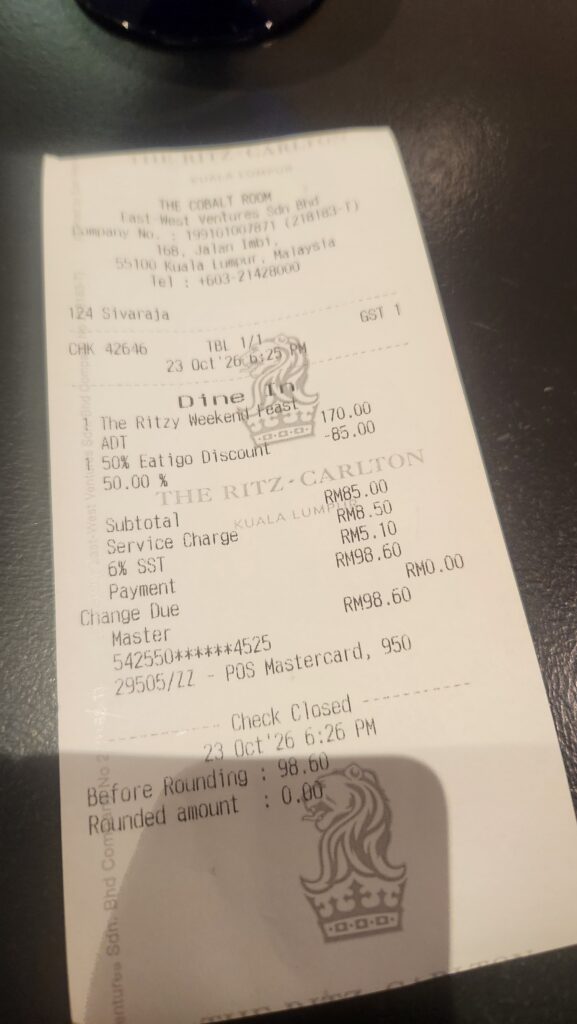
Viewed that way, the relevant number was never RM98.60. It was RM18.60, the marginal cost of upgrading my intended dinner. At that price, the upgrade was almost embarrassingly easy to justify. The oysters had lost the tender before I even reached the Ritz.
There Was Another Market Friction Hiding in the Story
There is one final part of this story that I found interesting. The discount existed whether or not I discovered it, but to benefit from it, I had to search. Economists have long recognised that information is not costless: consumers incur search costs when comparing prices, checking alternatives and verifying whether apparently attractive offers are actually what they seem.
Digital platforms lowered those search costs substantially. What struck me that evening was how much generative AI lowered them again.
Within minutes, standing on a food street in the rain, I was able to identify a competing product, scrutinise its terms, examine the exclusions, compare the effective price, check recent diner experiences and decide whether the apparent pricing anomaly was genuine. My ChatGPT buddy did not make the decision for me; it reduced the information cost of making the decision confidently. That distinction matters.
A consumer who sees “50% off” but suspects a catch may simply ignore it, while a consumer who can verify the offer within minutes may actually transact. In other words, reducing information asymmetry can change behaviour even when it does not change the underlying price.
There is something wonderfully absurd about this. Twenty years ago, somebody might have walked past the Ritz assuming it was beyond his dinner budget. In 2026, a wet man with an umbrella can stand outside a seafood stall, discover a pricing anomaly, consult an AI, conduct instant due diligence and redirect his dinner expenditure within minutes. Technology has apparently democratised many things, including being excessively analytical about scallops.
So Did I Hack Dinner?
Yes and no. Yes, I got a damn good deal. No, I did not discover a flaw in capitalism. The Ritz-Carlton was behaving rationally, Eatigo was behaving rationally, and, despite appearances, I was behaving rationally too.
The restaurant had perishable capacity and apparently weak demand for that particular sitting. Eatigo’s business model exists precisely to fill that sort of gap, and my kind of cheapskate was exactly the customer the pricing structure was designed to attract. I was not depriving the Ritz of RM170; without the discount, they would have received precisely RM0 from me. Instead, they got RM85 before charges, and I got slipper lobster. Trade occurred. Civilisation advanced.
The remarkable part was simply that all of this converged within a ten-minute walk. One moment, I was standing in the rain trying to decide how many RM10 oyster portions I needed before I would actually be full; the next, I was sitting in The Ritz-Carlton eating slipper lobster and sashimi while a live band played nearby. My planned dinner had gone from RM80 to RM98.60, but the product I purchased had changed almost beyond recognition.
Perhaps there is no profound lesson here. Sometimes economics is not about grand policy questions or complicated curves on a whiteboard. Sometimes it is simply the little voice in your head saying: Hang on. Three oysters, two scallops, two chicken… RM80? And somewhere in the rain, the valuer-accountant smells a rat.











Leave a Comment
Your email address will not be published. Required fields are marked with *