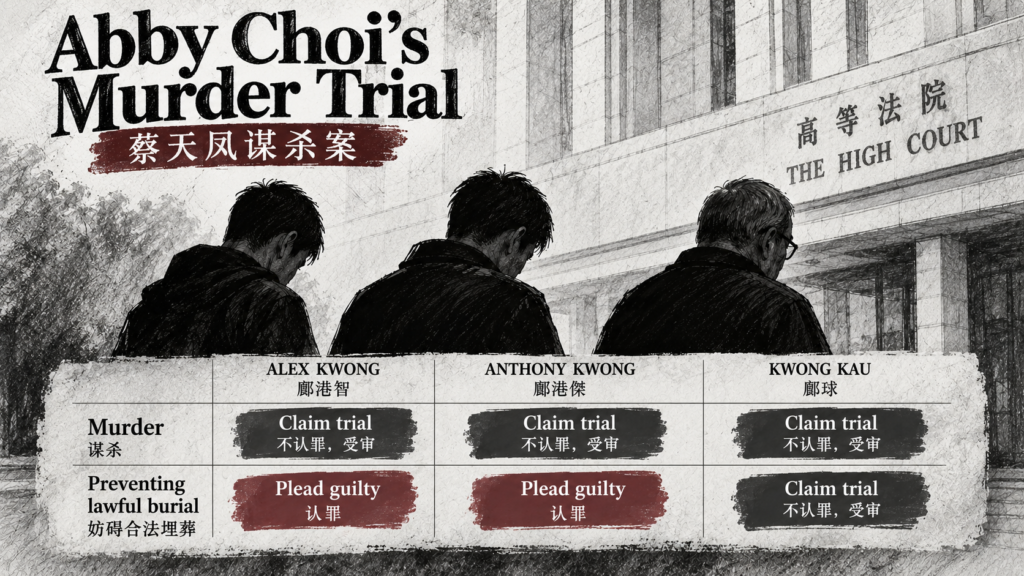
Two accused admit helping dispose of Abby Choi’s body, yet deny murdering her. A third denies both. What might explain these seemingly peculiar pleas? By working backwards from the plea matrix, this article examines how evidence, timing and common purpose may shape the strategic battlefield in a multi-accused murder trial.
By Boo Kok Chuon
I still remember the shocking news of Abby Choi Tin-fung’s (蔡天鳳) death in February 2023.[^1] I was only in my second month of law school then. Like many people following the news, my attention was naturally drawn to the gruesome circumstances in which her remains were discovered and the arrest of members of her former husband’s family.
More than three years later, the case has finally reached trial before the High Court of Hong Kong.[^2] Choi’s former husband Alex Kwong Kong-chi (鄺港智), his elder brother Anthony Kwong Kong-kit (鄺港傑), and their father Kwong Kau (鄺球) are jointly charged with her murder.[^3] All three have pleaded not guilty.
What caught my attention this time, however, was another charge. Alex and Anthony pleaded guilty to preventing the lawful burial of Choi’s body between 21 and 23 February 2023.[^4] Kau pleaded not guilty to that charge as well.
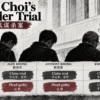
Their positions can therefore be reduced to a rather interesting table:
| Accused | Murder | Preventing lawful burial |
|---|---|---|
| Alex Kwong | Not guilty | Guilty |
| Anthony Kwong | Not guilty | Guilty |
| Kwong Kau | Not guilty | Not guilty |
At first sight, this may seem peculiar. If Alex and Anthony admit participating in the unlawful disposal of Choi’s body, how can they deny murdering her? Conversely, if Kau allegedly participated in the same sequence of events, why did he not simply plead guilty to the disposal charge like his sons?
We do not know the confidential instructions given to their lawyers, the advice they received, or the actual strategic reasoning behind their pleas. What follows is therefore not an attempt to describe their actual defence strategies. Rather, I thought it would be interesting to work backwards from the pleas and ask what legal and evidential considerations might rationally explain them.
Three years ago, I followed the case wanting to know what happened to Abby Choi. Today, the question that interests me more is slightly different: what exactly can the prosecution prove that each accused did?
What the Prosecution Says Happened
The prosecution’s case begins with a property dispute. Choi had purchased a luxury apartment at Kadoorie in Ho Man Tin, although the property was registered in Kau’s name.[^5] She subsequently decided to sell it. The prosecution alleges that the proposed sale caused relations between Choi and Kau to deteriorate and supplied the motive for what followed.[^6]
Several weeks before Choi disappeared, Kau rented a ground-floor unit at Lung Mei Village in Tai Po.[^7] A series of purchases followed. On 2 February 2023, Kau inspected the property while making eleven telephone calls to his two sons to finalize rental arrangements. Beginning 7 February, the family members systematically purchased equipment across various retail locations.[^8] The prosecution says Kau purchased items including an electric saw, meat mincer, large cooking pot, refrigerator and other equipment.[^9] Anthony purchased a hammer on 15 February 2023, which the prosecution alleges was subsequently used to attack Choi.[^10] The prosecution has also told the jury that Kau made inquiries about machinery capable of processing bones.
On 21 February 2023, Anthony drove Choi ostensibly to collect her daughter from school.[^11] Alex subsequently joined them. The prosecution alleges that Alex attacked Choi with the hammer inside the vehicle while Anthony was driving, rendering her unconscious or killing her before they arrived at Lung Mei.[^12] A hammer later recovered from the Lung Mei property bore DNA from Alex Kwong, and Choi’s head injuries were shown to the jury as consistent with blows from a hammer.[^13]
The vehicle subsequently met Kau. CCTV records activity involving a large plastic container, which Kau and Anthony were later seen carrying into the premises.[^14] The prosecution says Choi was inside that container. A nearby resident later reported hearing the sound of an electric saw,[^15] and when police searched the premises on 24 February, parts of Choi’s remains were discovered there—her legs in a refrigerator and her skull and several ribs in a large metal soup pot.[^16]
Viewed globally, the prosecution therefore presents a single coherent narrative:
motive → preparation → procurement → collection of Choi → attack → transportation → disposal.
It is an extremely powerful narrative if the evidence ultimately proves it.
But this is also where lawyers start becoming irritating. Instead of looking only at whether the story makes sense as a whole, we start taking it apart.
One Victim, Three Cases
The prosecution tells one story. The jury must decide three cases.
That distinction is important because evidence establishing one proposition does not necessarily establish another, and evidence against one accused does not automatically become evidence of the same conduct by another.
Take the electric saw. There is evidence that Kau purchased an electric saw. There is evidence that Choi’s body was subsequently dismembered. There is also evidence placing Kau at Lung Mei. It would be very easy to compress those propositions into a much simpler sentence: Kau dismembered Choi.
But at least from the evidence publicly reported so far, there does not appear to be direct evidence identifying Kau as the person who physically operated the saw upon Choi’s body. That does not mean the prosecution cannot prove his participation circumstantially, nor does it mean that a person must personally perform every physical act before he can be criminally liable. It simply means we should not allow one fact to quietly become another without noticing the inference in between.
This is where the concept of actus reus, traditionally used to describe the physical element of an offence, becomes useful. Buying a saw is an act. Using the saw is another. Helping someone use it is another. Participating in a common criminal enterprise pursuant to which somebody else uses it may create yet another route to liability.
They may ultimately lead to the same criminal responsibility. But they do not get there by the same road.
And once we start separating the roads, the different pleas become much more interesting.
Why Might Alex and Anthony Plead Guilty to Disposal?
Consider a simple hypothetical. A kills V. Only after V has died does A telephone B and tell him what happened. B then deliberately assists A in disposing of V’s body.
B has plainly engaged in criminal conduct. But B’s willingness to help after V’s death does not, without more, prove that B agreed beforehand that V should be killed.
The distinction is temporal. In a case such as Choi’s, the alleged events can conceptually be divided into:
| Stage | Event |
|---|---|
| T1 | Planning |
| T2 | Preparation |
| T3 | Victim collected |
| T4 | Fatal attack |
| T5 | Transportation of body |
| T6 | Disposal |
An accused might admit criminal participation at T5 and T6 while denying participation in, knowledge of, or agreement concerning T1 to T4. There is nothing inherently contradictory about that position.
This provides one possible explanation for why an accused might plead guilty to preventing lawful burial while continuing to claim trial to murder. If the objective evidence overwhelmingly establishes participation in disposal, there may be little strategic value in denying the obvious. A blanket denial may merely require counsel to spend credibility fighting propositions that cannot realistically be contested.
A more focused defence position might instead be expressed this way: yes, my client participated in disposing of the body. He has admitted the offence constituted by that conduct. Now prove that he participated in the murder.
The strategic proposition is therefore quite simple:
Concede the act; contest what the act proves.
The accused need not deny carrying a container, entering the premises or assisting with disposal if those matters are objectively established. He may nevertheless insist that the prosecution prove that he shared the requisite criminal purpose concerning the killing itself.
That changes the battlefield considerably. Rather than asking the jury to believe that nothing happened, the defence can potentially say: where our client committed an offence, he admitted it. The remaining question is whether the prosecution has proved the much more serious offence that he has not admitted.
Importantly, none of this means that a guilty plea to disposal somehow protects the accused from the murder case. The prosecution remains perfectly entitled to argue that the disposal was not an isolated act arising after an unexpected death, but the final stage of a plan formed much earlier.
And that is precisely why the evidence concerning T1 to T4 matters.
But the Prosecution Gets to Push the Timeline Backwards
Suppose Anthony says, conceptually, that his admitted criminality relates only to what happened after Choi died. The prosecution’s obvious response would be to point to everything that happened beforehand: the equipment purchases, communications, vehicle arrangements, his meeting with Alex, his role in collecting Choi and his presence during the alleged attack.
Likewise, an admission of disposal by Alex does not prevent the prosecution from relying upon the hammer, forensic evidence, his movements and the alleged attack inside the vehicle to prove murder.
The real contest therefore becomes one of chronology. The defence seeks to place a boundary somewhere around T4:
| before death | after death |
|---|
The prosecution seeks to demolish that boundary by arguing that the later disposal was simply the completion of a criminal enterprise which had already begun at T1.
Seen this way, a guilty plea to disposal does not necessarily weaken the prosecution case or strengthen the defence case by itself. What it can do is clarify precisely where the remaining fight lies.
Then Why Might Kau Plead Not Guilty to Everything?
This is where the plea matrix becomes even more interesting.
If Alex and Anthony can rationally admit disposal while contesting murder, why might Kau refuse to admit even disposal?
Again, we cannot know his actual reasoning. But the publicly reported evidence suggests a possible analytical explanation: the evidence against the three men is not identical.
The prosecution attributes substantial preparatory conduct to Kau. It says he rented the Lung Mei premises, purchased equipment including the electric saw, mincer, refrigerator and large cooking pot, enquired about machinery capable of processing bones, obtained telephone SIM cards, and was present at Lung Mei. CCTV also records him and Anthony carrying a large plastic container into the premises.[^17]
Those are potentially powerful pieces of circumstantial evidence.
But notice what many of them prove directly.
The tenancy proves that he rented the premises.
The receipts and CCTV may prove that he purchased equipment.
The footage may prove that he carried the container.
His presence proves that he was there.
What they prove about his personal participation in the subsequent treatment of Choi’s remains may require further inference.
That distinction potentially matters if the prosecution’s case against Alex and Anthony contains direct or overwhelming evidence of particular post-death acts which makes contesting the disposal charge unattractive, whereas Kau considers there remains something worth contesting about his own role.
In other words, the question is not simply: if the sons pleaded guilty, why didn’t the father?
The better question is: what evidence does the prosecution have against each of them for the particular offence?
A co-accused is not required to inherit another accused’s plea merely because they appear in the same narrative.
This is perhaps the most important reason for looking at the plea table before looking at the case as a family unit. Three defendants may stand in the same dock, but each is entitled to require the prosecution to prove the offence charged against him.
The Prosecution Must Be Strategic Too
There is another dimension to the guilty pleas which I find particularly interesting from a litigation perspective.
Where a plea involves an agreed factual basis or formal admissions, the precise wording can matter. Suppose the prosecution agrees to the following proposition:
“After Choi was killed, D learned of her death and thereafter agreed to assist in disposing of her remains.”
At first sight, that seems perfectly sensible if D is pleading guilty to the disposal offence. But look carefully at what has just been agreed. The sentence does not merely establish disposal. It potentially establishes a chronology:
Choi dies → D learns what happened → D becomes involved.
If the prosecution’s murder case is that D was part of the plan before Choi died, why voluntarily agree to language potentially suggesting that his knowledge began afterwards?
A narrower factual formulation might simply state:
“Between approximately XX:XX hours and YY:YY hours, D knowingly assisted with the disposal of Choi’s body by performing specified acts.”
That admits what is necessary for the disposal offence without unnecessarily saying when D first acquired knowledge, when his involvement began, or whether he knew beforehand that Choi would be killed.
The interests of both sides are therefore almost mirror images. Defence counsel would naturally consider whether the factual basis of a guilty plea can resolve one charge without unnecessarily prejudicing the remaining defence. Prosecuting counsel must ensure that resolving one charge does not inadvertently concede a factual proposition which assists the accused on another.
A guilty plea may end one contest while quietly shaping the battlefield for the next.
But Who Actually Has to Swing the Hammer?
There is an obvious complication with everything I have said so far. The prosecution does not necessarily have to prove that each defendant personally performed the physical act that killed Choi.
Hong Kong continues to recognise principles of joint criminal enterprise.[^18] Put simply, where several persons participate in a common criminal enterprise with the necessary state of mind, criminal responsibility may extend beyond the person who personally inflicts the fatal injury.[^19]
For Singapore readers, the underlying idea should be familiar. Section 34 of our Penal Code provides that where a criminal act is done by several persons in furtherance of the common intention of all, each may be liable as if he had done the act himself. The doctrines are not identical, but the practical point is similar: the prosecution does not necessarily have to prove that every participant personally swung the hammer.
The more important questions may therefore be: was there a common criminal purpose? What was its scope? When did each accused join it? And was Choi’s killing carried out pursuant to that purpose?
Timing again becomes crucial. A common purpose to dispose of a corpse is not automatically a common purpose to create the corpse.
That is why seemingly mundane evidence preceding the killing may assume enormous importance. A gruesome exhibit recovered afterwards may establish what happened to Choi. A receipt issued weeks earlier may help establish who knew what was going to happen before it happened.
Common Purpose Is Not the Same as Conspiracy
There is also a temptation to use “common purpose” and “conspiracy” interchangeably. They are related, but they are not quite the same thing.
A conspiracy centres upon an agreement to pursue a criminal course of conduct. Joint enterprise or common purpose concerns the basis upon which responsibility for an offence committed pursuant to a shared enterprise may extend to participants who performed different roles.
On the facts, however, the same evidence may be relevant to both concepts. If several people allegedly planned an offence together, there is unlikely to be a document conveniently titled Minutes of Meeting: Proposed Murder of Abby Choi. The existence and scope of any agreement will usually have to be inferred from conduct.
Who rented the premises? Who bought the equipment? Who communicated with whom? Who arranged the vehicles? Who collected Choi? Who was present before and afterwards? Were their movements coordinated?
The prosecution asks the jury to assemble those pieces and infer a pre-existing common criminal purpose. The defence is entitled to ask whether those pieces necessarily establish the particular purpose alleged.
Proof that several people coordinated something does not automatically establish precisely what they agreed to do.
The Two Competing Reconstructions
By this stage, the dispute can be reduced to two competing ways of reading substantially the same chronology.
| Prosecution reconstruction | Possible defence reconstruction |
|---|---|
| The Lung Mei premises and equipment were obtained in preparation for killing Choi and disposing of her body. | Procurement or presence must be proved against each accused and does not by itself establish the scope of his knowledge or intention. |
| The defendants’ movements and communications show a coordinated plan existing before Choi was collected. | Coordination may prove some common activity without necessarily proving that every accused shared a purpose to kill. |
| The attack, transportation and disposal were different stages of one premeditated enterprise. | Participation in later stages does not by itself establish participation in the earlier killing. |
| Subsequent disposal conduct supports the inference that the defendants knew of and participated in the plan from the beginning. | Post-death conduct may establish a disposal offence while leaving reasonable doubt as to when knowledge or participation began. |
| Kau’s procurement, presence and conduct at Lung Mei form part of the same planned operation. | Each act attributed to Kau must still be identified precisely; procurement, presence and container handling should not automatically be converted into proof that he personally performed every alleged disposal act or shared the murderous purpose. |
This, to me, is where the different pleas become intelligible.
Alex and Anthony may have concluded that there was little purpose in contesting the disposal offence while believing that the prosecution should still be put to proof on murder.
Kau may have concluded that the evidence concerning his own conduct justified putting the prosecution to proof on both.
Those are only possible reconstructions. They are not assertions about the defendants’ actual instructions or legal advice.
But they demonstrate why the plea matrix is not necessarily peculiar at all.
Evidence Does Not Travel by Teleportation
The prosecution’s case is powerful precisely because it invites the jury to assemble many individual pieces into one continuous narrative. That is how circumstantial cases are proved.
The defence’s task is almost the reverse. It separates those pieces and asks what each one actually establishes.
Kau bought the saw. Therefore Kau used the saw.
Kau helped carry the container. Therefore Kau participated in dismemberment.
Kau participated in events at Lung Mei. Therefore Kau participated in murder.
Perhaps the prosecution will ultimately prove every one of those propositions. The point is not that any of them is necessarily wrong. The point is that every “therefore” contains an inferential step, and the inferential step cannot disappear merely because the overall story is compelling.
The same discipline applies to Alex and Anthony.
The prosecution tells one story. The jury must decide three cases.
That is not pedantry. That is reasonable doubt at work.
I find it interesting that a case I first encountered during my second month of law school has now returned just as my own legal education is approaching its end. Three years ago, I followed the case wanting to know what happened to Abby Choi. Today, I find myself asking rather different questions: What did each accused actually do? What did he know? What did he intend? What did he agree with the others to do?
And perhaps most importantly:
When?
Disclaimer
This article discusses an ongoing criminal trial for educational and legal commentary purposes. References to the prosecution’s case describe allegations and inferences advanced in court and should not be treated as findings of fact. The discussion of possible defence and prosecution strategies is hypothetical and does not purport to describe the confidential instructions, advice or strategy of any party. All accused persons remain presumed innocent of charges to which they have pleaded not guilty.
Footnotes
[^1]: Abby Choi Tin-fung, born 15 July 1994, went missing on 21 February 2023 after failing to collect her daughter from school. Her dismembered remains were discovered by Hong Kong police on 24 February 2023 at a house in Lung Mei Tsuen, Tai Po. The case attracted significant media attention throughout Hong Kong and internationally due to the gruesome circumstances and the prominence of the victim in Hong Kong society.
[^2]: The murder trial began on 21 September 2026 before the High Court of Hong Kong, presided over by Deputy Judge Sir Brian Keith, in a courtroom with substantial public interest. The jury selection proceeded over several days, with a nine-member jury (eight men and one woman) eventually empanelled on 30 September 2026 after an initial panel had to be discharged due to a juror seeking withdrawal on health grounds. The trial was expected to last approximately 45 working days and continue into December 2026. See Murder of Abby Choi, Wikipedia (accessed October 2026); HKFP, “Murder trial opens for ex-husband and in-laws of Hong Kong socialite Abby Choi” (21 September 2026).
[^3]: The three accused are: Alex Kwong Kong-chi (鄺港智), age 32, who is unemployed; Anthony Kwong Kong-kit (鄺港傑), age 35, who worked as Choi’s personal driver; and their father Kwong Kau (鄺球), age 69, who is retired. All three are jointly charged with murdering Abby Choi on 21 February 2023 and with preventing the lawful burial of her body between 21 and 23 February 2023.
[^4]: Alex and Anthony Kwong pleaded guilty to preventing the lawful burial of a body (or obstructing the lawful burial of a body) between 21 and 23 February 2023, while maintaining their pleas of not guilty to the murder charge. Kwong Kau pleaded not guilty to both charges.
[^5]: Abby Choi purchased a luxury apartment at Kadoorie Hill in Ho Man Tin for approximately HK$72.8 million (US$9.3 million). The property was registered in the name of her former father-in-law, Kwong Kau, allegedly to avoid higher tax obligations. After Choi’s divorce from Alex Kwong, she continued to provide financial support to the family and maintained close relationships with her former in-laws.
[^6]: The prosecution alleges that Choi’s decision to sell the property prompted Kwong Kau to refuse to sign necessary authorization documents, fearing that he and his family would lose the property title and the lifestyle it afforded. Voice messages recorded in October 2022, shortly before Choi’s death, captured Choi expressing anger toward the Kwong family regarding the property dispute, stating that she had purchased the home for her children’s sake while the family had contributed nothing and acted ungratefully.
[^7]: Kwong Kau rented the ground-floor unit at Lung Mei Village in Tai Po on 2 February 2023, making multiple telephone calls to his two sons during the inspection to finalize the rental arrangements. The premises was rented for HK$10,000 per month.
[^8]: Beginning 7 February 2023, the three defendants were seen visiting multiple retail locations and purchasing a range of items over a two-week period prior to Choi’s death. The prosecution presented evidence of CCTV footage showing these shopping trips and purchases.
[^9]: The items allegedly purchased by the defendants included: an electric saw (also described in some reports as an electric chainsaw), a meat mincer (or meat grinder), large stainless-steel stockpots, a refrigerator, large chopping boards, plastic storage boxes, rain boots, gloves, deodorizing supplies, and other equipment. The prosecution alleges that all items purchased by Kau and Anthony Kwong were eventually recovered from the Lung Mei village house.
[^10]: Anthony Kwong purchased a hammer on 15 February 2023. The prosecution alleges this hammer was used to attack Choi on 21 February 2023. A hammer recovered from the Lung Mei property bore DNA from Alex Kwong. Jurors were shown autopsy photographs of Choi’s head injuries, with the prosecution contending they were consistent with blows from a hammer. According to the prosecution’s opening address, Choi’s injuries included a cracked jaw matching the impact of the hammer.
[^11]: Choi was reported missing on 21 February 2023 after failing to collect her daughter from school. The prosecution alleges that Anthony Kwong, acting as Choi’s personal driver, drove her ostensibly to collect her daughter, with Alex subsequently joining them in the vehicle.
[^12]: The prosecution alleges that Choi’s final messages stopped at 2:44 pm on 21 February 2023, at which point Alex allegedly attacked Choi with the hammer inside the vehicle. Blood and DNA evidence from both Alex and Anthony Kwong was found in the vehicle.
[^13]: The hammer recovered from the Lung Mei property bore DNA from Alex Kwong. Jurors were presented with autopsy photographs documenting Choi’s injuries, including blows to her head with a cracked jaw.
[^14]: CCTV footage recorded Kwong Kau and Anthony Kwong carrying a large plastic container into the Lung Mei premises. The prosecution alleges Choi’s body was inside the container during transportation.
[^15]: A resident living near the Lung Mei property reported hearing the sound of an electric saw (or electric chainsaw) on the afternoon of 21 February 2023. The resident also reported noxious odours from the premises, which the prosecution alleges were directly tied to the defendants’ efforts to dispose of Choi’s body.
[^16]: When police searched the premises on 24 February 2023, three days after Choi’s disappearance, parts of her dismembered body were discovered. Her legs were found in a refrigerator, while her skull and several ribs were found in a large metal soup pot. Additional remains, including her torso and hands, were not found at the crime scene. The electric saw and meat slicer believed to have been involved in the dismemberment were also recovered.
[^17]: The prosecution attributes the following preparatory conduct to Kwong Kau: renting the Lung Mei premises, purchasing equipment including the electric saw, meat mincer, refrigerator and large cooking pot, making inquiries about machinery capable of processing bones, obtaining telephone SIM cards, presence at the Lung Mei property on 21 February 2023, and participation in carrying the plastic container into the premises as captured on CCTV footage.
[^18]: Hong Kong continues to recognize the common law doctrine of joint criminal enterprise as a basis for criminal liability. In HKSAR v Chan Kam Shing FACC 5/2016, the Hong Kong Court of Final Appeal confirmed that joint enterprise liability remains part of Hong Kong criminal law in both its “basic” and “extended” forms. A party to a joint criminal enterprise participates in a joint criminal enterprise during which an offence is committed by the principal acting in concert and with a common design. Liability is founded at common law and is recognized in section 89 of the Criminal Procedure Ordinance, Cap 221 (Laws of Hong Kong).
[^19]: Under Hong Kong law, secondary parties to a joint criminal enterprise are equally liable as principal offenders. Where several persons participate in a common criminal enterprise with the necessary state of mind, criminal responsibility may extend beyond the person who personally inflicts the fatal injury. The existence and scope of any common purpose is ordinarily inferred from conduct, including planning, communications, procurement, and the coordinated movements and roles of the participants.













Leave a Comment
Your email address will not be published. Required fields are marked with *