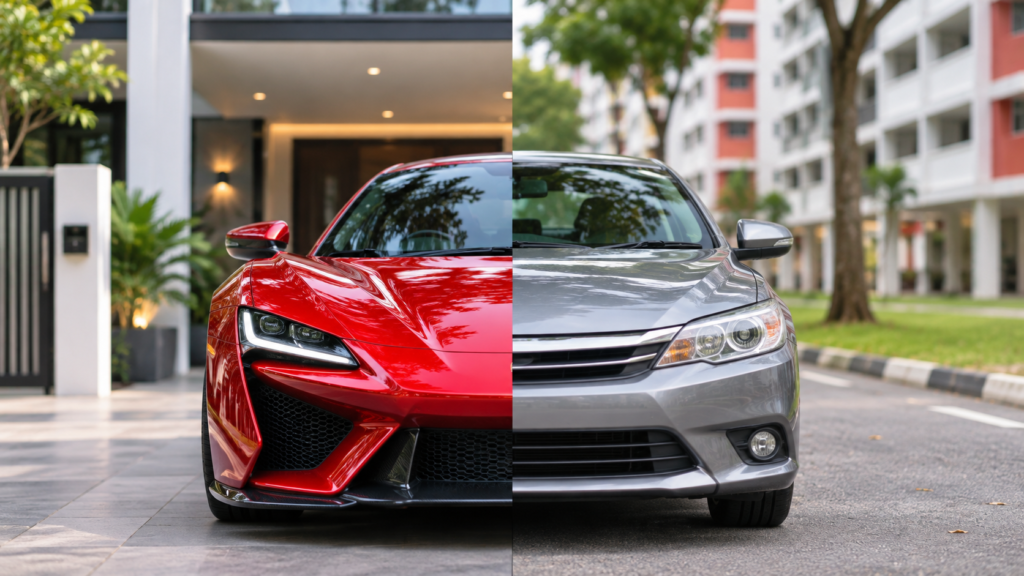
Singapore should move away from an increasingly obsolete engine-and-power COE classification towards a value-based one. But the failure of the present boundary does not, by itself, establish that the purpose behind maintaining differentiated access has disappeared.
By Boo Kok Chuon
On 19 October 2026, I submitted a response to the Land Transport Authority’s public consultation on the proposed changes to Singapore’s Certificate of Entitlement categorisation system for passenger cars.
My position is not that the present Category A and B system should be preserved as it is. In fact, one of the easier conclusions to reach from LTA’s consultation paper is that engine capacity and power output are increasingly poor proxies for whether a car belongs in the mass-market or higher-value segment.[1]
Electric vehicles make the weakness particularly obvious, but the problem is wider than EVs. Engine size and power are technical characteristics; they no longer tell us particularly reliably where a car actually sits in the market.
On that part, I agree with LTA. Where I became less convinced was in moving from that diagnosis to the possibility of merging Categories A and B altogether and using a value-based feebate to restore the differentiation between cheaper and more expensive cars.
The fact that a boundary has become badly drawn does not necessarily tell us that there should no longer be a boundary. It may simply mean that the fence needs to be moved.
Why Was the Fence There?
This became the question that bothered me most while researching the paper. When the earlier passenger-car categories were consolidated into Categories A and B in 1999, the Government said that two categories were retained “to maintain progressivity in the COE system”.[2]
That matters because it changes the nature of the policy question. If categorisation existed merely to control congestion, there would be a strong argument for asking why we need two categories at all: a Toyota and a Ferrari each consume one unit of COE quota, and the aggregate quota already controls the number of vehicles entering the population.
Categorisation performs a different function. The total quota decides how many cars may be registered, while the categories influence which buyers compete against one another for portions of that fixed supply.
Once those two functions are separated, the merger question stops looking like a matter of administrative tidiness. It becomes a question of market design and distribution.
This is also why I do not object to moving towards value as the relevant classification concept. My own paper proposes relative median Open Market Value as a more sensible starting point than engine capacity or power, with periodic review so that the boundary continues to reflect the market rather than slowly becoming obsolete again.
What I am less comfortable assuming is that a fixed-dollar feebate operating inside one common auction necessarily performs the same distributional function as keeping buyers in separate quota pools. The two mechanisms simply do different things.
A feebate changes the effective price faced by bidders. If one vehicle receives a $7,500 advantage over another, its buyer has some additional room to bid before the economic difference is exhausted.
That certainly gives buyers of lower-value cars some protection, and my paper does not deny it. What it does not do is reserve any particular part of the quota for them.
Once everybody competes in the same pool, the result depends on how much different groups are willing to pay and how quickly they withdraw as the clearing price rises. That is where I ran into an evidential problem.
What We Know, and What We Do Not
Singapore’s household data show a very clear relationship between income and car availability. In the 2023 Household Expenditure Survey, car availability ranged from 17.0 per cent among households in the lowest income quintile to 56.6 per cent in the highest, and the same general gradient appears in earlier survey rounds.[3]
Those figures are important, but they do not tell us how households respond to changes in COE prices. I do not think we should make the data prove more than they actually prove.
Foreign research does suggest that price responsiveness can vary materially by income. Leard and Wu, for example, find markedly different new-vehicle demand elasticities across income groups in the United States.[4]
That evidence cannot simply be transplanted into Singapore. What I could not find in the public material was a Singapore estimate of COE price responsiveness broken down by household-income or vehicle-value group.
That missing variable matters because a merged auction could behave very differently depending on those elasticities. If buyers of higher-value cars are systematically more willing to pay, or less sensitive to price, the common clearing price could rise above the price that would otherwise have cleared a separate mass-market pool.
More buyers of lower-value cars could then drop out before the quota is exhausted. That is a plausible mechanism, but plausibility is not evidence that it will actually happen in Singapore.
This is why the paper treats crowding out as something that should be modelled, not something that should be asserted as an inevitable result.
The Existing System Does Not Get a Free Pass
The difficulty runs both ways. It would be convenient for anyone opposing merger to describe the present two-pool structure as though segmentation were inherently progressive, but the evidence does not support that proposition either.
One of the most useful papers I found was Ling Hui Tan’s study of Singapore’s Vehicle Quota System, first issued as an IMF Working Paper and subsequently published in IMF Staff Papers.[5] Tan confirms that equity concerns were part of the rationale for subcategorisation, but she also shows that the historical system could produce the opposite outcome when the individual quotas were badly calibrated.
At various points, buyers of inexpensive cars bore a heavier burden relative to vehicle value than buyers of expensive cars. That is adverse evidence against a simple defence of segmentation, and I think it has to be taken seriously rather than explained away because it is inconvenient to my preferred position.
Tan’s work also makes the policy choice less binary than it first appears. Her own alternative was not LTA’s proposed common pool with a fixed-dollar feebate, but a single quota using proportional bids.
By the end of my research, I therefore no longer saw the choice as simply “two categories or one”. There are at least three designs worth comparing: a value-based two-pool model, LTA’s merged pool with a fixed-dollar feebate, and a proportional single-quota model of the kind examined by Tan.
I am not prepared to say that the first is inherently superior. I am equally not prepared to say that defects in historical segmentation establish that the second will perform better.
That is why the principal recommendation in my submission is really one of sequencing: change the classification first, model the merger second, and decide whether to merge after that.
Model the Merger Before Implementing It
LTA could estimate Singapore-specific price responses across vehicle-value bands, simulate the clearing price under a merged pool and examine how successful registrations would be distributed across different OMV ranges. The proposed $7,500 and $15,000 adjustments could then be stress-tested against estimated reservation prices and behavioural responses rather than assessed mainly by reference to historical differences between Category A and B premiums.
I would also want to see the distributional outcome, not merely whether the new system produces lower premium volatility or a cleaner auction structure. The relevant comparison is whether the merged system preserves or improves progressivity against both vehicle value and household income.
If it does, I have no particular attachment to maintaining Categories A and B. Merge them.
My objection is narrower: the obsolescence of the present boundary does not itself prove that the underlying segmentation function has become obsolete. Nor does it establish, without modelling, that a fixed-dollar price instrument inside a common pool will reproduce the distributional effect that the separate pools were intended to achieve.
Renewal Is a Different Question
The renewal issue took me down a slightly different path. At first acquisition, the logic of a value-based adjustment is relatively easy to understand: a buyer choosing between a cheaper and a more expensive car can face different effective prices, and that price signal may influence the choice.
Ten years later, the economic character of the transaction has changed. The car has aged, its market value may be completely different, and the person renewing it may not even be the person who originally bought it.
If the original OMV classification follows the vehicle into renewal, we therefore need to ask what exactly the surcharge is intended to represent at that point. Is it still pricing the original consumption choice, discouraging retention of historically expensive cars, encouraging fleet turnover, proxying the present wealth of the owner, or simply putting another price on scarce road capacity?
Those are different policy objectives and they may require different instruments. If road capacity is the concern, there is also an obvious further question because the owner already pays the Prevailing Quota Premium for the renewed entitlement.
None of this establishes that a renewal feebate must be wrong. It means the justification used at acquisition should not simply be carried across to renewal without asking whether the same reasoning still fits the decision being regulated.
My fallback position is therefore prospective treatment. A future purchaser who buys after the new regime comes into force can take the renewal consequences into account when deciding what vehicle to acquire, whereas someone who purchased under the present framework could not have done so.
The legal analogy I used in the submission was Abdul Nasir bin Amer Hamsah v Public Prosecutor, where the Court of Appeal separated the adoption of a new interpretation from the question of its prospective temporal effect.[6] The case concerned criminal sentencing, not COE regulation, and I do not rely on it as authority that existing vehicle owners have a vested right to the current regime.
Its relevance is narrower. A rule may legitimately change while the question of which earlier transactions should bear the new consequence remains a separate matter of transition, notice and regulatory design.
Conclusion
The conclusion I can support from the evidence presently available is a relatively narrow one. Singapore should move away from an increasingly obsolete engine-and-power classification towards a value-based one, but the failure of the present boundary does not by itself establish that the purpose behind maintaining differentiated access has disappeared.
The more important question is whether a merged pool with a fixed-dollar feebate can preserve or improve the distributional outcome that the present categorisation was intended to serve. That is something that can and should be modelled before the structure of the market is permanently changed.
Hence the title of the supporting paper: Move the Fence, Do Not Demolish It.
If the modelling eventually shows that the fence serves no useful purpose, or that another mechanism performs the same function better, demolish it then. Until we know that, moving it to the right place seems the more defensible first step.
Readers who are interested in the underlying data, economic literature, historical policy materials, counterarguments, renewal analysis and detailed recommendations can read the full 46-page submission below.
Full Paper
Boo Kok Chuon, Submission on the COE Categorisation Public Consultation: Why Singapore Should Recalibrate COE Categories A and B Before Any Merger (Zenodo, 2026), DOI: 10.5281/zenodo.23875164.
https://doi.org/10.5281/zenodo.23875164
References
[1] Land Transport Authority, COE Categorisation Public Consultation Paper (8 October 2026).
[2] Land Transport Authority, COE Categorisation Public Consultation Paper (8 October 2026), on the 1999 retention of two passenger-car categories to maintain progressivity; see also Ministry of Transport, Parliamentary Ministerial Statement on Meeting the Transport Needs of Singaporeans (8 May 2023).
[3] Singapore Department of Statistics, Report on the Household Expenditure Survey 2023 (November 2024), Chart 5.19, p. 79.
[4] Benjamin Leard and Yichen Wu, “New Passenger Vehicle Demand Elasticities: Estimates and Policy Implications” (Resources for the Future Working Paper 23-33, August 2023).
[5] Ling Hui Tan, “Rationing Rules and Outcomes: The Experience of Singapore’s Vehicle Quota System” (2001) IMF Working Paper WP/01/136; subsequently published in (2003) 50(3) IMF Staff Papers.
[6] Abdul Nasir bin Amer Hamsah v Public Prosecutor [1997] SGCA 38 at [69]–[75] and [87]. The case is cited by analogy on prospective temporal treatment only; it did not concern COE regulation or administrative reform.
Suggested Citation
BOO, K. C. (2026). Submission on the COE Categorisation Public Consultation: Why Singapore Should Recalibrate COE Categories A and B Before Any Merger. Zenodo. https://doi.org/10.5281/zenodo.23875164












Leave a Comment
Your email address will not be published. Required fields are marked with *