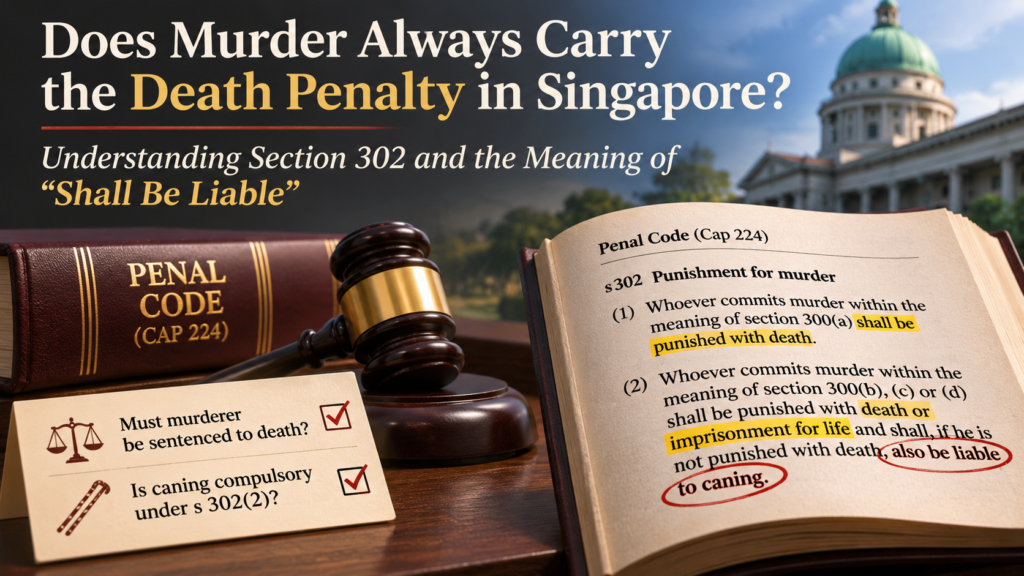
Does a murder conviction always mean the death penalty? And does “shall be liable to caning” make caning compulsory? A closer look at section 302, Mahat, Poh, and Parliament’s 2012 explanation.
On 5 November 2026, the Singapore High Court sentenced Huang Bocan to life imprisonment for the murder of his younger sister, Huang Baoying, in Public Prosecutor v Huang Bocan [2026] SGHC 232. The case involved prolonged abuse which ultimately caused the death of the 19-year-old victim. Although Huang was convicted of murder, the court imposed life imprisonment rather than the death penalty. No caning was ordered. [1]
The decision provides an opportunity to clarify two interesting aspects of Singapore’s criminal law. First, does a conviction for murder necessarily attract the death penalty? Second, where the Penal Code provides that an offender “shall … also be liable to caning”, does this mean that caning is compulsory? Both questions can be answered by examining the language of the Penal Code and how our courts have interpreted it.
1. Does Murder Necessarily Carry the Death Penalty?
A common misconception is that anyone convicted of murder in Singapore must be sentenced to death. This was generally the position before the legislative amendments enacted in 2012, which came into effect on 1 January 2013. The amendments introduced judicial discretion in sentencing for certain categories of murder. [2]
Under the present framework, section 302 of the Penal Code distinguishes between two categories of murder. Section 302(1) provides:
“Whoever commits murder within the meaning of section 300(a) shall be punished with death.”
This applies to murder under section 300(a), where the offender causes death with the intention of causing death. The death penalty remains mandatory for this category of murder.
However, section 302(2) provides:
“Whoever commits murder within the meaning of section 300(b), (c) or (d) shall be punished with death or imprisonment for life and shall, if he is not punished with death, also be liable to caning.” [3]
Unlike subsection (1), subsection (2) expressly allows the court to impose either the death penalty or life imprisonment.
The distinction is important because the legal definition of murder is broader than intentionally killing another person. For instance, under section 300(c), an offender may be guilty of murder if he intentionally inflicts a particular bodily injury which is objectively sufficient, in the ordinary course of nature, to cause death. It is not necessary to establish that he specifically intended to kill the victim.
This was the provision under which Huang Bocan was convicted, read together with section 34 of the Penal Code concerning common intention. Consequently, although murder remains among the most serious offences under Singapore law, not every murder conviction necessarily results in a death sentence. The applicable sentencing framework depends on which category of murder under section 300 has been established.
2. What Does “Shall Be Liable to Caning” Actually Mean?
This brings us to a more curious question of statutory interpretation. Under section 302(2), where the death penalty is not imposed, the offender must be sentenced to life imprisonment and shall also be liable to caning.
To an ordinary reader, the word “shall” might suggest that caning must invariably accompany a life sentence. However, in legal drafting, there is an important distinction between the expressions “shall be punished with” and “shall be liable to”.
This distinction was examined by the High Court in Public Prosecutor v Mahat bin Salim [2005] SGHC 83. [4]
In that case, Yong Pung How CJ considered several Penal Code provisions prescribing imprisonment together with additional punishment. Some provisions stated that an offender “shall also be punished with” caning, whereas others used the expression “shall also be liable to” caning or a fine.
At [27], Yong CJ explained that the expression “shall be liable” does not, prima facie, carry an obligatory or mandatory meaning. In other words, the offender becomes legally exposed to that punishment, but its actual imposition is not necessarily compulsory.
At [29], he further explained that where imprisonment was already prescribed as a mandatory punishment, the additional phrase “shall also be liable” did not automatically require the court to impose the supplementary punishment. The court retained discretion whether to order the additional fine or caning. Conversely, the expression “shall also be punished with” was treated as prescribing a mandatory additional punishment.
The distinction is subtle but significant. In the former situation, Parliament may authorise the court to impose an additional punishment. In the latter, Parliament requires that punishment to be imposed.
But Context Matters: Poh Boon Kiat v Public Prosecutor
The interpretation of these expressions was subsequently examined in Poh Boon Kiat v Public Prosecutor [2014] SGHC 186. [5]
In that case, Sundaresh Menon CJ considered the meaning of “shall be liable” in the sentencing provisions of the Women’s Charter. While acknowledging the general distinction recognised in earlier authorities, including Mahat, he cautioned against treating the phrase as an inflexible rule of interpretation.
At [36], Menon CJ emphasised that the meaning of “shall be liable” must be understood by considering the provision in both its textual and legislative context. The court ultimately held that imprisonment was mandatory under the relevant Women’s Charter provisions, notwithstanding their use of the expression “shall be liable”, while the additional fine was discretionary.
This qualification is important. The phrase does not automatically confer discretion in every statute simply because the word “liable” appears. In certain contexts, the legislative framework may indicate that a punishment is intended to be mandatory, notwithstanding the use of that expression. Accordingly, the proper approach is to examine not merely the individual words, but the structure of the provision, the other punishments prescribed, and Parliament’s intention.
Applying These Principles to Section 302(2)
Returning to section 302(2) of the Penal Code, the statutory structure provides for death or life imprisonment. Where life imprisonment is imposed, caning is an additional punishment which the court is legally empowered to order.
The legislative history confirms that this additional punishment is discretionary. During the Second Reading of the Penal Code (Amendment) Bill on 14 November 2012, the then Minister for Law, Mr K Shanmugam, expressly explained at paragraph 8 of his speech: [6]
“In addition, where the Court orders life imprisonment, it is also given the discretion to order caning.”
Thus, the interpretation of section 302(2) is supported not only by the distinction discussed in Mahat and the contextual approach in Poh, but also by the express explanation given when the provision was introduced.
In practical terms, murder under section 300(b), (c) or (d) carries two statutory sentencing alternatives: death; or life imprisonment, with or without caning. Caning forms part of the sentencing framework associated with the life-imprisonment alternative, but its actual imposition remains a matter of judicial discretion.
Conclusion
The language of criminal legislation can sometimes be counterintuitive. Words that appear straightforward in everyday English may carry a more nuanced meaning when read within their statutory framework.
Section 302 illustrates two such distinctions. A conviction for murder does not invariably attract the death penalty, because Parliament has distinguished between different categories of murder and provided sentencing discretion under subsection (2). Likewise, an offender who “shall be liable to caning” is not necessarily required to receive caning, because liability to a punishment is not always equivalent to a statutory obligation to impose it.
The broader lesson is that statutory interpretation requires more than reading individual words in isolation. The text, its structure, judicial precedents and legislative history must be considered together to understand what Parliament intended. That is why, in law, even a seemingly simple word such as “shall” deserves a closer reading.
References
[1] Public Prosecutor v Huang Bocan [2026] SGHC 232, especially [4]–[6], [17]–[18] and [23] (High Court judgment dated 5 November 2026).
[2] Penal Code (Amendment) Act 2012 (Act 32 of 2012), which commenced on 1 January 2013.
[3] Penal Code 1871, sections 300 and 302, Singapore Statutes Online.
[4] Public Prosecutor v Mahat bin Salim [2005] SGHC 83, especially [25]–[30].
[5] Poh Boon Kiat v Public Prosecutor [2014] SGHC 186, especially [29]–[36].
[6] Second Reading Speech by Minister for Law K Shanmugam on the Penal Code (Amendment) Bill, 14 November 2012, especially paragraphs 5–10.

















Leave a Comment
Your email address will not be published. Required fields are marked with *