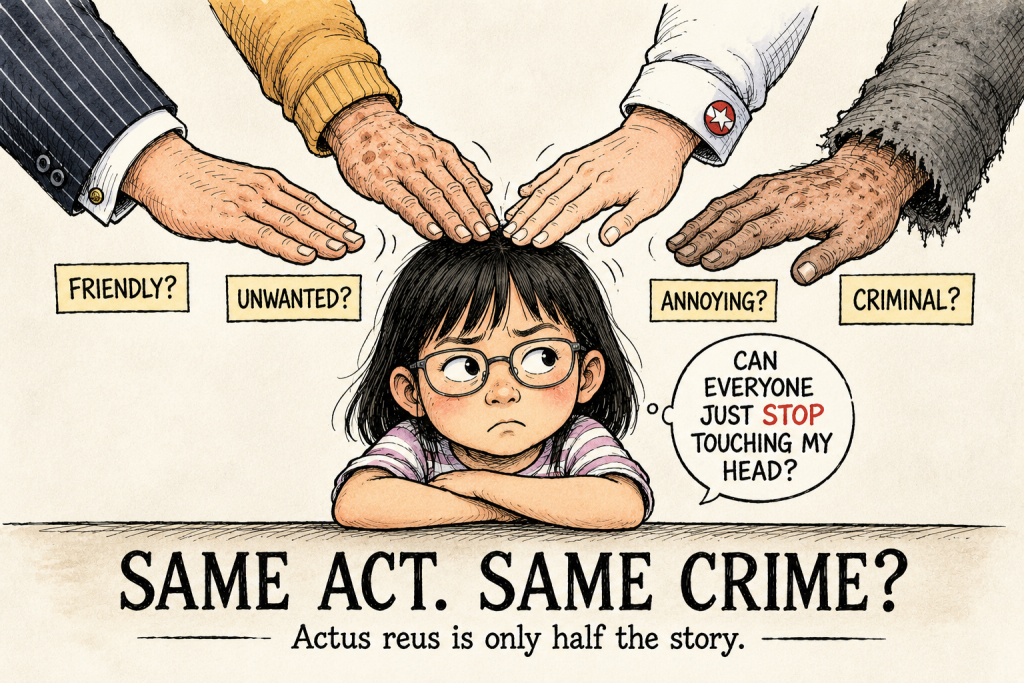
By Boo Kok Chuon Over the past few days, the incident at a Roxy Square food court involving 73-year-old wanton noodle seller Yeo Song Khoon has attracted considerable public attention. CCTV footage showed Mr Yeo briefly patting a young girl on the head before he was subsequently shoved to the ground by the girl’s father.
By Boo Kok Chuon
Over the past few days, the incident at a Roxy Square food court involving 73-year-old wanton noodle seller Yeo Song Khoon has attracted considerable public attention. CCTV footage showed Mr Yeo briefly patting a young girl on the head before he was subsequently shoved to the ground by the girl’s father. The incident has since generated a heated discussion, not only over the shove, but also over the seemingly simple gesture that preceded it: was it wrong for Mr Yeo to pat the child on the head without her consent?
I do not intend to discuss the subsequent altercation. Police investigations are ongoing and there is little value in publicly speculating about the possible criminal liability of anyone involved before the facts have been properly established.
What interests me instead is the debate over what happened immediately before it. The elderly man had reportedly patted a young girl on her head.
Was he entitled to do so without her consent?
The question has generated some interesting comparisons. Some have pointed to prominent public figures patting children on their heads during community events. Others have changed the hypothetical: what if the person being patted were a teenage girl or an adult woman? What if the elderly man were not a familiar stallholder at the coffeeshop, but a complete stranger whom people found unsettling?
These are useful questions because they expose a distinction which is easily lost in an emotionally charged discussion.
We can quite reasonably say that people should respect another person’s personal boundaries. It does not necessarily follow that every unwanted physical contact constitutes a criminal offence.
The difference takes us back to two of the most basic ideas in criminal law: the phyiscal element — actus reus and the fault element — mens rea.
An Act Alone Does Not Tell the Whole Story
Actus reus is commonly used to describe the prohibited physical element of an offence, while mens rea concerns the requisite fault element or state of mind. Singapore’s Penal Code 1871 (“Penal Code”) now uses the terms “physical element” and “fault element” in section 22A, with the latter referring to a state of mind required to establish liability, including intention, knowledge, rashness and negligence.
The distinction matters because criminal liability cannot ordinarily be determined by isolating a few seconds of physical movement from everything surrounding it.
Take something as ordinary as placing a hand on another person’s shoulder. An old friend may do it instinctively while greeting someone he has not seen for years. The physical contact is deliberate and there may have been no express invitation to do so, but those facts alone tell us very little about criminal liability.
The Penal Code’s treatment of “criminal force” illustrates the point particularly well.
Sections 349 and 350 define “force” and “criminal force” respectively. Section 350 does not simply provide that intentional force without consent is necessarily criminal force. The provision requires something further, including, depending on the limb relied upon, an intention illegally to cause or knowledge that the force is likely illegally to cause injury, fear or annoyance.
There is also a more basic point which sometimes disappears in online legal discussions. Sections 349 and 350 are definition provisions. Even if conduct falls within a statutory definition, we still have to identify the provision creating the particular offence and establish its ingredients.
This may sound technical, but the underlying idea is straightforward.
Criminal law does not punish vocabulary. It punishes offences.
What if the Person Being Touched Were a Teenage Girl?
This is where some of the comparisons circulating online become interesting.
Suppose instead of a young child, the person being touched were a teenage girl. Or suppose an adult man briefly patted an adult woman on the head without first asking her permission.
Does changing the age or sex of the person being touched necessarily turn the act into a crime?
No.
If the suggestion is that the conduct amounts to outrage of modesty under s 354 of the Penal Code, for example, the prosecution must establish an assault or use of criminal force accompanied by an intention to outrage the person’s modesty, or knowledge that the conduct is likely to do so.
A conventional brief pat on someone’s head, without anything more, would ordinarily provide no sensible basis for inferring an intention to outrage that person’s modesty or knowledge that this was likely to occur.
The analysis changes when the facts change. Persistent touching after an objection, sexually suggestive remarks, the nature and location of the contact, or other surrounding conduct may provide evidence from which the necessary state of mind can be inferred.
That is the important distinction. Context matters because it is evidence of mens rea. It does not replace mens rea.
The victim’s age or sex may form part of that factual context, but neither supplies the missing fault element by itself.
I Put the Question to Kiki
The discussion made me curious about how my own daughter would react.
I asked Kiki what she would do if a stranger uncle suddenly patted her on the head.
She did not require much time to consider the question. She said she would feel irritated, push his hand away and instinctively shout at him to stop.
That answer did not particularly surprise me. What interested me was what happened when I reminded her of a rather different encounter we had previously had at a coffeeshop.
An elderly cleaner had walked over while she was eating a char siew bao and asked whether it was nice. She nodded. He then jokingly asked:
“可以请我吃吗?”
What happened next surprised even us. Kiki picked up the extra char siew bao on her plate and offered it to him.
The uncle laughed and told her he was only teasing her. He had already eaten breakfast. He then praised her for being thoughtful, we thanked him, everyone laughed, and that was the end of the encounter.
So I asked her why she would happily offer food to that stranger, yet become irritated if another stranger patted her head.
Her answer was wonderfully uncomplicated:
“Because he didn’t touch me. And that uncle was kind.”
There are two different ideas in that answer.
The first is about personal boundaries. She does not like strangers touching her. If somebody unexpectedly puts a hand on her and she does not like it, she is perfectly entitled to move the hand away and tell the person to stop.
The second is about context. She had interpreted the cleaner uncle’s words and behaviour and formed an impression of the interaction, just as all of us do instinctively every day.
But criminal law asks a different question.
Kiki needs no legal justification for saying, “Don’t touch me.”
The State needs considerably more before it can say, “You have committed a criminal offence.”
What if He Were a “Creepy Homeless Uncle”?
This hypothetical is worth examining because it exposes another problem in the way we sometimes reason about criminal conduct.
Imagine that the same brief pat on the head came from an unkempt homeless man whom observers instinctively found “creepy”. Does that change the legal analysis?
His appearance may change our emotional reaction. His homelessness should not change the ingredients of the offence.
“Creepy” is not a mens rea. Being poor, dishevelled or socially awkward does not supply one either.
Otherwise, we would arrive at a troubling proposition where substantially identical conduct becomes more readily characterised as criminal when performed by someone whom society instinctively distrusts.
Of course, the wider circumstances remain relevant. If the stranger had been following the child, repeatedly attempting physical contact despite objections or behaving in some other manner relevant to the alleged offence, those facts might support an inference about his intention or knowledge.
But that is precisely the point.
We rely on those circumstances because they are evidence. We do not substitute our impression of the person for proof of the required state of mind.
The Space Between “Acceptable” and “Criminal”
Perhaps much of the disagreement comes from treating social conduct as though there were only two boxes.
If behaviour is acceptable, it goes into one. If we consider it inappropriate, we instinctively put it into the other and start asking what offence has been committed.
Human interaction does not divide so neatly.
A person may cross someone else’s personal boundary without satisfying the ingredients of a criminal offence. Equally, describing conduct as “just touching” does not make it harmless where the nature of the contact and surrounding circumstances establish the physical and fault elements of an offence.
That is why asking “Did he touch her without consent?” may be relevant, but it cannot always conclude the inquiry.
We still have to identify the offence alleged, determine its physical and fault elements, and consider whether the available evidence proves them.
Only then are we analysing criminal liability rather than expressing a view about social etiquette.
Personal Boundaries and Criminal Liability Are Different Questions
I think it is perfectly reasonable for parents to teach their children that they are entitled to personal boundaries. I certainly want Kiki to know that she can object firmly if somebody touches her in a way that makes her uncomfortable.
Her answer to me was perfectly sufficient for that purpose:
“I don’t like it. Stop.”
She does not need to establish actus reus or mens rea before saying that.
But once the discussion moves from whether conduct was welcome to whether another human being has committed a criminal offence, the standard necessarily changes.
The physical act matters. So does the fault element required by the particular offence. Context matters because it helps us determine what actually happened and, where appropriate, what may reasonably be inferred about the person’s state of mind.
There is therefore nothing inconsistent in respecting someone’s personal boundaries while recognising that not every unwanted touch is necessarily criminal.
The two propositions operate in different registers.
One tells us how we ought to treat one another.
The other determines when the coercive power of the criminal law may properly be brought to bear.
Confusing the two does neither any favour.















Leave a Comment
Your email address will not be published. Required fields are marked with *