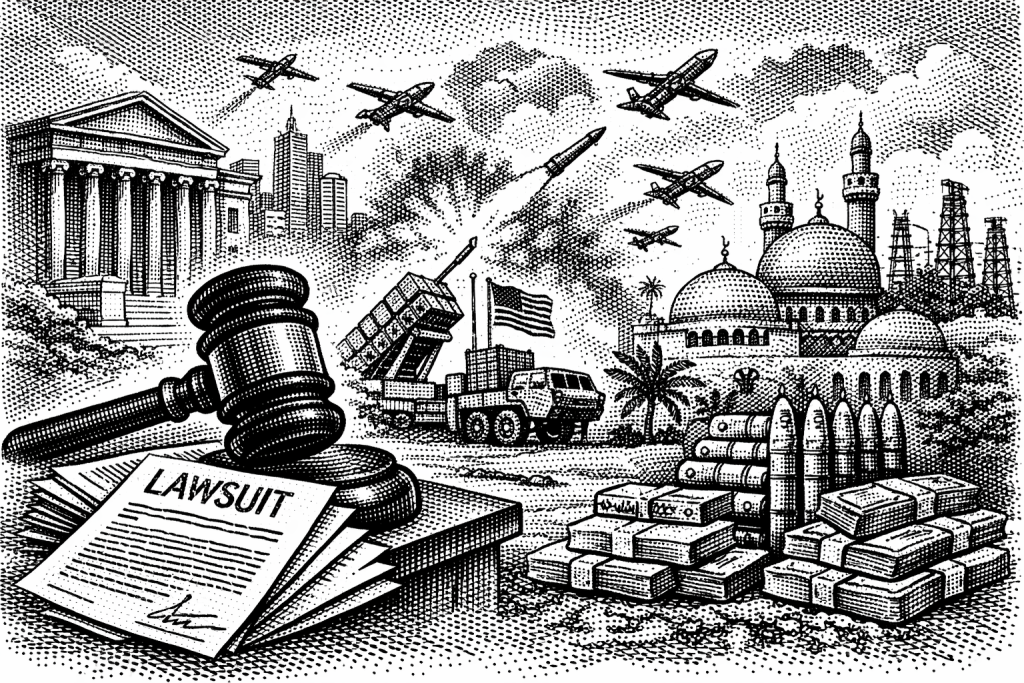
By Boo Kok Chuon Modern conflicts, whether in courtrooms or on battlefields, are increasingly decided not by force alone, but by economics. In commercial litigation, experienced practitioners quickly learn that the filing of a claim can trigger consequences far beyond the courtroom. A simple Statement of Claim lodged in the State Courts can immediately activate
By Boo Kok Chuon
Modern conflicts, whether in courtrooms or on battlefields, are increasingly decided not by force alone, but by economics.
In commercial litigation, experienced practitioners quickly learn that the filing of a claim can trigger consequences far beyond the courtroom. A simple Statement of Claim lodged in the State Courts can immediately activate internal risk protocols within banks and financial institutions. Credit facilities may be reviewed. Compliance departments may flag litigation exposure. Counterparties may reassess commercial relationships.
All of this can occur before the defendant is even formally served with the claim.
In effect, the economic pressure of litigation begins long before the procedural contest truly unfolds.
This is why the duration of litigation matters. The longer a dispute drags on, the more damage it can inflict on the defendant. Legal costs accumulate. Management attention is diverted. Financing becomes more difficult. Strategic opportunities are delayed or lost.
Even where the defendant ultimately prevails, the economic damage sustained during the process may already be significant.
In many commercial disputes, therefore, the real contest is not purely legal.
It is economic.
War by Other Means
Recent events in the Iran war reveal an uncanny resemblance to the economics of litigation.
U.S. President Donald Trump launched a major military campaign against Iran early this month, triggering the current conflict across the Middle East.
Iran has relied heavily on large numbers of inexpensive one-way attack drones such as the Shahed-136. These drones are estimated to cost approximately US$20,000 to US$50,000 each.
The missiles used to intercept them, however, can cost around US$4 million per interceptor.
This creates a striking cost asymmetry.
A weapon costing tens of thousands of dollars can force the defender to expend millions.
Pleading in the Alternative – Military Edition
The tactic bears an uncanny resemblance to pleading in the alternative in litigation.
When a claimant pleads multiple alternative causes of action, the objective is not that every claim must succeed. The claimant only needs one viable claim to survive scrutiny.
Drone warfare operates on the same logic.
Dozens or hundreds of inexpensive projectiles may be launched. Most may be intercepted. But the defender must intercept every single one. If even one slips through, the objective may already be achieved.
In litigation terms, this is the equivalent of pleading multiple causes of action e.g. negligence, misrepresentation, breach of contract, unjust enrichment etc.
Most may fail. One is enough.
The Cost of Interception
Military analysts increasingly describe modern drone warfare as a contest of cost-exchange ratios.
Cheap drones impose expensive defensive responses. A Shahed drone costing tens of thousands of dollars may trigger the launch of a Patriot interceptor costing several million.
Over the opening phase of the conflict, analysts estimate that the United Arab Emirates alone may have spent between US$1.45 billion and US$2.28 billion intercepting incoming missiles and drones during the early exchanges.
In litigation terms, the analogy is familiar.
A low-cost claim forces the opposing party to incur massive defence expenditure.
Cheap attack. Expensive defence.
Flipping the Economics of the Conflict
Iran’s decision to strike U.S. bases located in neighbouring Gulf countries may appear, at first glance, to be an escalation.
In reality, it is also a tactical move to alter the economics of the war.
Following the initial U.S.–Israeli strikes on Iran, Tehran launched retaliatory attacks not only against Israel but also against U.S. military installations across the Gulf region, including bases in Bahrain, Kuwait, Qatar and Saudi Arabia.
These countries host American military assets but are not the principal belligerents in the conflict.
By striking U.S. bases located on their soil, Iran effectively regionalises the cost of the war.
Instead of forcing the United States alone to bear the cost of defending its operations, the burden now spreads across multiple neighbouring states. These states must activate their own air-defence systems, intercept incoming missiles and drones, and absorb the economic disruption that follows.
In litigation language, Iran has effectively joined neighbouring states as co-defendants in the economics of the war.
Analysts note that Iran’s strategy is to demonstrate that no U.S. ally in the region is beyond reach, thereby increasing the cost of supporting Washington’s campaign.
In other words, Iran is attempting to transform the conflict from a bilateral confrontation into a regional cost-sharing problem.
The Invisible Economic Leakage
The deeper economic damage lies elsewhere.
The UAE’s economic model depends heavily on tourism, international investment, and its reputation as a stable global hub. Missile alerts, airspace disruptions, and heightened geopolitical risk inevitably weaken investor confidence.
Tourism bookings fall. Airlines reroute flights. Insurance premiums rise. Investors delay commitments.
Unlike military expenditure, these losses do not appear in defence budgets. They manifest instead as slow but persistent leakage in economic activity.
And once confidence is damaged, rebuilding it can take years.
The Strategic Lesson
Both litigation and modern warfare reveal the same underlying principle:
Cost asymmetry can determine outcomes long before victory is formally declared.
In litigation, every allegation must be answered.
In missile defence, every projectile must be intercepted.
The attacker needs only one success.
The defender must stop them all.
Whether the weapons are pleadings or drones, the mathematics remains the same: the side that controls the economics of the fight usually controls the outcome.
Litigation is often described as warfare by other means.
Modern drone warfare, it appears, may simply be litigation economics with explosives.














Leave a Comment
Your email address will not be published. Required fields are marked with *