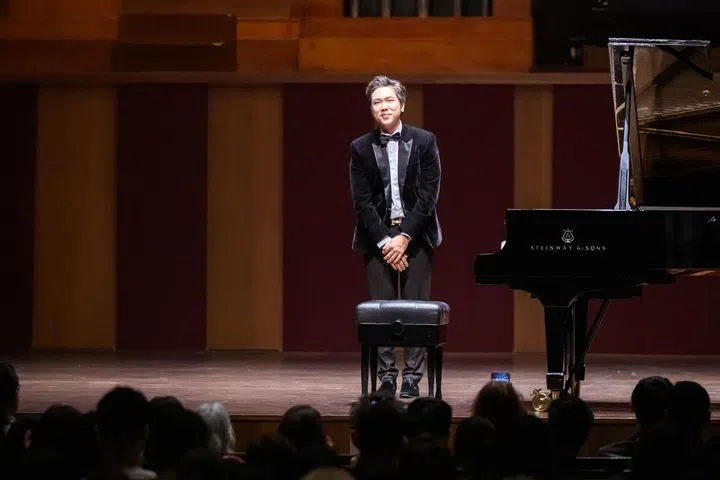
By Boo Kok Chuon A recent review of pianist Wang Congyu’s recital at Victoria Concert Hall in The Straits Times by pianist, Geoffrey Lim, prompted me to reflect on the broader ethics of criticism. In the arts, criticism is not merely inevitable, it is necessary. A vibrant cultural life depends on the willingness of writers,
By Boo Kok Chuon
A recent review of pianist Wang Congyu’s recital at Victoria Concert Hall in The Straits Times by pianist, Geoffrey Lim, prompted me to reflect on the broader ethics of criticism. In the arts, criticism is not merely inevitable, it is necessary. A vibrant cultural life depends on the willingness of writers, performers and audiences to engage seriously with one another’s ideas.
In that sense, the review itself was part of a long tradition of musical discourse. Critics interpret performances, just as performers interpret scores. Both participate in shaping how audiences understand art. Yet interpretation has never been governed by rigid formulas.
Frédéric Chopin is often quoted as telling Liszt, “When you do me the honor of playing my compositions, play them as they are written or not at all.” At first glance the remark appears to demand strict obedience to the score. Yet Chopin also urged his own students, “Put all your soul into it, play the way you feel.”
This distinction gives rise to what might be called the Chopin Framework: a simple principle governing the relationship between composer, score and performer.
The score is not a cage but a charter. It contains everything the composer expressly required: every note, every rhythm, every dynamic marking. What it does not contain is silence. And silence, by its nature, cannot be prescribed. It is within these unwritten spaces that the performer’s interpretative responsibility begins.
Thus, whatever is written must be respected; what is not written invites interpretation. A performer who renders every note faithfully has honoured the text. What follows, phrasing, tempo, colour, the shaping of inner voices, is not alteration but animation. It is the difference between Liszt, who embellished Chopin’s themes in the salon, and the student whom Chopin urged to “put all your soul into it, play the way you feel.”
In the review itself lies an important acknowledgement: Wang is described as “more than capable of playing the notes.” In other words, the written text of Chopin and Ravel was never in dispute. The reservations expressed concern what the critic calls “internal voices not indicated in the score.” Yet under this framework, such voices belong precisely to the interpretative space that the score leaves open. When the written notes are accounted for, what remains is not prohibition but possibility.
The reviewer is consistent with what I have witnessed: Wang did not alter the written work, but neither does he merely reproduce it mechanically. As Claude Debussy would later observe, “Works of art make rules; rules do not make works of art.” Between fidelity to the text and freedom of expression lies the space where interpretation lives.
The disagreement, therefore, is not about textual fidelity. Wang played what was written. The question is how the unwritten spaces are shaped. That question has always belonged to interpretation. Interpretation, as Debussy reminds us, cannot be reduced to rigid rules.
Precisely because classical works continue to invite new readings, criticism too benefits from resisting absolutist conclusions about how music must or must not be played.
Yet the episode also reminded me of something Jeff Bezos once attributed to his grandfather: “It is harder to be kind than clever.” The remark was not meant to discourage cleverness, but to remind us that intellect without restraint can easily become careless.
Criticism carries unusual power because it operates in public. A few sentences written behind a screen can influence how thousands of readers perceive an artist’s work. This influence does not invalidate criticism, but it does place ethical weight on how it is exercised.
Responsible journalism, therefore, demands an even greater sense of proportionality. When criticism appears on a national platform, the reach and permanence of the words are significantly amplified. The imbalance of power between a widely read publication and an individual artist means that the consequences of those words can extend far beyond the concert hall, shaping public perception long after the performance itself has faded from memory. Precisely because criticism is valuable to cultural life, it must also be practised with an awareness of the weight it carries.
My own philosophical view of ethics is quite simple, though not necessarily easy to practise.
First: do no foreseeable harm when unprovoked.
This principle asks us to exercise awareness before we act or speak. In many professions, be it journalism, law, the arts, words travel far beyond the moment they are written. They shape reputations, influence audiences, and sometimes linger long after the event itself has passed. Ethical restraint at this stage does not mean silence or avoidance of criticism. It simply means asking a basic question before we speak: Is the harm that may arise from these words necessary to the purpose they serve?
Second: exercise restraint when provoked.
Public discourse inevitably produces disagreement. Artists face criticism; critics face rebuttal; audiences form their own opinions. In such moments, the temptation to respond immediately and forcefully is strong. Yet restraint is often the quiet discipline that prevents disagreement from descending into hostility. It allows space for reflection and preserves the dignity of all parties involved.
Third: exercise proportionality when pushed to the limits of endurance.
There are circumstances where response becomes unavoidable. Ethical restraint does not demand passivity in the face of persistent or unjust harm. But even when response is necessary, proportionality matters. A measured reply preserves the possibility of dialogue, whereas excess often destroys it.
Taken together, these principles form a simple hierarchy:
avoid harm where possible, restrain reaction where necessary, and respond proportionately only when there is no other option left.
It was through this lens that I found myself reflecting on the recent concert review. The critic had earlier written to the artist requesting a pair of complimentary tickets to the recital, which the artist gladly offered. Such exchanges are not unusual in the arts. Journalists, performers and organisers often meet within the same cultural ecosystem, each playing a different role in sustaining public engagement with the arts.
This detail does not diminish the critic’s independence. Critics must remain free to form their own judgments. Yet it serves as a reminder that criticism does not exist in a vacuum. It takes place within a community of artists, writers and audiences whose shared objective, at its best, is the flourishing of culture.
Perhaps this is ultimately what a mature arts culture asks of us: not uniform agreement, but thoughtful engagement conducted with care and grace.
In music, as in criticism, interpretation will always differ. The real test of a cultural community is not whether disagreements arise, but whether those disagreements deepen our understanding of the art we claim to value.
And in that endeavour, kindness may sometimes demand more discipline than cleverness.












Leave a Comment
Your email address will not be published. Required fields are marked with *