By Boo Kok Chuon Most consumers assume that a warranty is a promise. In practice, it is often a process. And between promise and process, there is a gap. This is a short account of what happens inside that gap. The Purchase On or about 4 August 2025, I purchased multiple mobile devices from Carousell
By Boo Kok Chuon
Most consumers assume that a warranty is a promise.
In practice, it is often a process.
And between promise and process, there is a gap.
This is a short account of what happens inside that gap.
The Purchase
On or about 4 August 2025, I purchased multiple mobile devices from Carousell Mobile directly under the Carousell Certified Mobile programme. In respect of two of these devices, I separately purchased 12-month extended warranty coverage at S$43.90 per device.
Each device was accompanied by its own warranty coverage. Each warranty was separately priced and paid for.
No issue arose at the point of sale.
The Fault
Subsequently, one of the devices, a Samsung Galaxy S23 Ultra 5G (256GB, Phantom Black), developed a green line on the display.
The issue was visible and persistent.
A warranty claim was initiated.
The Process
On 11 April 2026 at approximately 12:14 PM, I contacted Carousell Mobile via its designated messaging channel to initiate the claim.
I was informed that a record had to be created before the service centre could proceed.
Order details were provided.
What followed was a sequence of redirections: from messaging to application; from application to email; from email to a “dedicated team”. No operative step was taken within that chain.
Each node acknowledged. None executed.
The Shift
At that point, the issue was no longer the defect.
It was classification.
The request was being treated as a standard customer service inquiry.
The situation, however, required immediate operational execution.
The language of communication was adjusted accordingly.
Structured instructions were issued:
1. to classify the request as real-time
2. to create the warranty record
3. or to escalate to an authority capable of doing so
The objective was not persuasion.
It was reclassification.
The Response
Within minutes, the matter was escalated. At approximately 12:57 PM, a human representative responded via email, acknowledged the claim, and directed me to attend the Carousell Mobile Service Centre at Chinatown Point.
The loop had ended.
The Attendance
On 12 April 2026 at approximately 2:04 PM, I attended at the service centre and delivered the device.
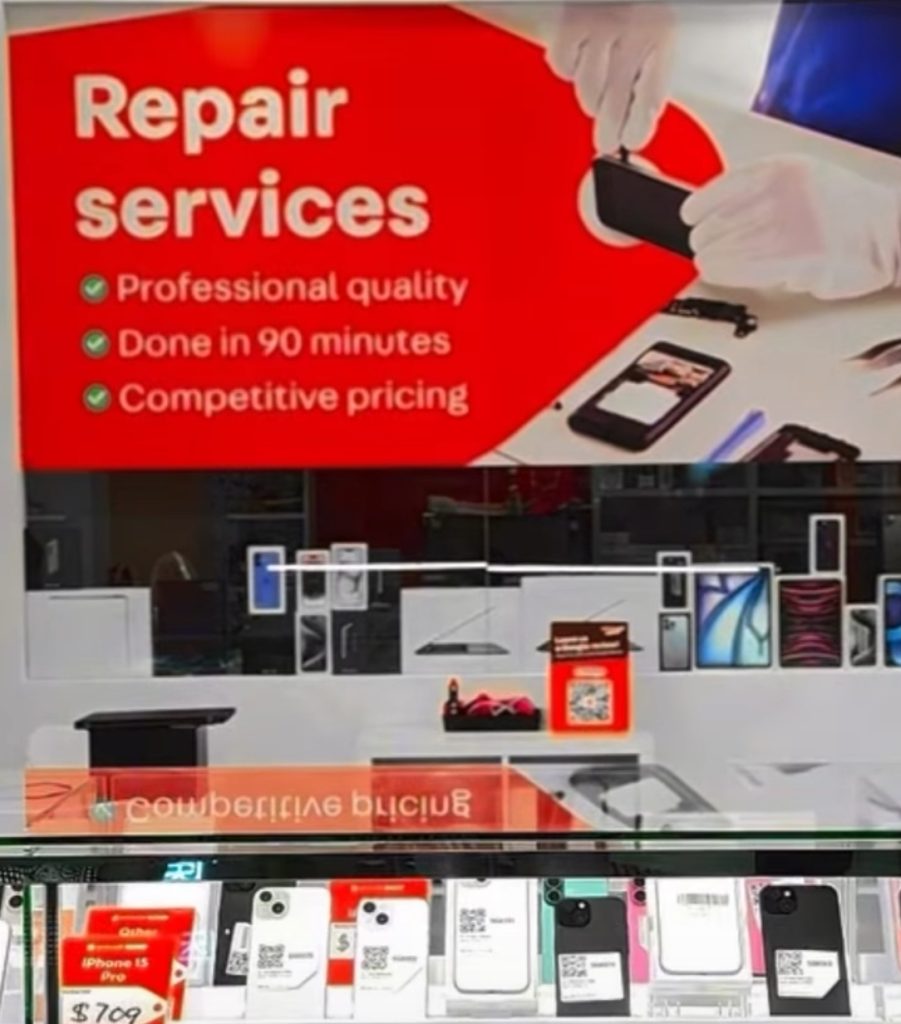
At the premises, a banner prominently represented a “90-minute repair turnaround”.
I had, the evening prior, confirmed my attendance within 15 minutes of receiving confirmation of the claim. The service team therefore had the entirety of the morning to prepare.
Upon attendance, I was informed that the required screen component was not in stock and would need to be ordered.
I was further informed that the repair would be ready at or around 8:00 PM the same day.
The Record
The timeline was recorded:
1. confirmation of claim
2. confirmation of attendance
3. time of arrival (2:04 PM)
4. representation at the premises (90 minutes)
5. revised completion time (8:00 PM)
The Adjustment
Carousell Mobile confirmed that the repair would proceed under warranty and be completed the same day.
Separately, it had earlier indicated that Lalamove collection could be arranged at no cost.
A question was raised: Whether that arrangement could apply equally to the return of the device upon completion.
No further argument was made.
The Outcome
Carousell Mobile subsequently confirmed that it would proceed with delivery of the repaired device to my residential address.
The device was to be repaired under warranty.
The logistics were to be borne by the service provider.
All communications were conducted in writing and contemporaneously recorded.
The Observation
At no point was the underlying defect in dispute.
At no point was the existence of warranty coverage in dispute.
The progression of the matter turned instead on:
1. how the request was classified
2. how the system responded to that classification
3. and how quickly that classification changed
The Position
A warranty is not tested at the point of sale.
It is tested at the point of inconvenience.
If the process required to activate it introduces sufficient friction, the practical value of the warranty becomes a matter for consideration.
The facts above are set out for that purpose.













Leave a Comment
Your email address will not be published. Required fields are marked with *