By Boo Kok Chuon Why DIY Estate Planning and Implied Trusts Make for Expensive Regrets What you have created is valid on its face. What you have not asked is a far more dangerous question: Did you actually have the right to give away what you just gave? Picture this. You’re doing up your will.
By Boo Kok Chuon
Why DIY Estate Planning and Implied Trusts Make for Expensive Regrets
What you have created is valid on its face.
What you have not asked is a far more dangerous question:
Did you actually have the right to give away what you just gave?
Picture this.
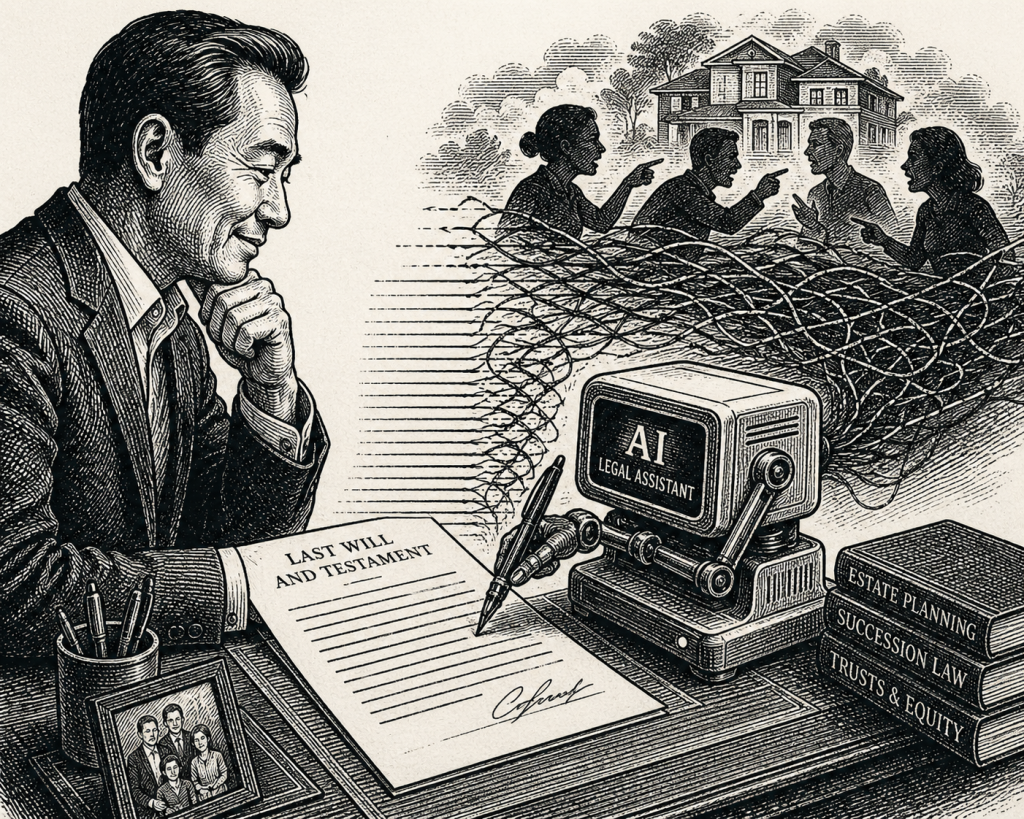
You’re doing up your will. Your lawyer sends you a quote. You stare at it and think, this one ah… two pages only, likely 30 minutes work, why so expensive?
So you do what any rational person in 2026 would do:
You open ChatGPT. Key in your details. Let it work its magic.
Boom.
Instant will. Atas legal jargons. Proper structure. Perfect formal formatting.
You feel like you’ve outplayed your lawyer. Saved a few hundred dollars.
Maybe even wondering if lawyers are next on the extinction list.
And to be fair, the will looks perfectly fine. You know you’re going to also avoid the common traps of requiring two witnesses who are not beneficiaries.
Sounds Legit Right?
But here’s the problem:
A will can be perfectly drafted and still be fundamentally wrong.
Because a will does not ask whether you own what you are giving away, and neither does it question if what you don’t own in name can actually be yours.
The Everyday Arrangements Nobody Documents
Consider something far more familiar.
You bought a property. It’s in your name.
It’s got a lone. Your son pays the monthly instalments. Not occasionally, but consistently, over time.
You treat it as him serving his filial duty. No agreement. No discussion about ownership.
Or how about this:
One of your houses ages. Repairs pile up. The bathroom leaks. The air-conditioning fails.
You tell your daughter residing in it:
“You settle the repairs first. Next time, this house will be yours.“
She pays. Renovates. Maintains. Upgrades.
Nothing is written.
Just family.
Or this: quieter, but just as dangerous.
Your child is buying their first property. The bank needs a bigger down-payment. You have the cash. You step in with a SGD 150,000 cashier’s order from your hard-earned savings.
The property is in your child’s name. The mortgage is in your child’s name. You are not on the title.
In your mind, the calculation is simple:
I helped my child. That’s done.
You move on.
Years pass. The property appreciates. The mortgage gets paid. The contribution fades into the background.
One day, you draft your will. You didn’t mention the property.
Surely it’s his, isn’t it?
These arrangements feel normal.
But equity does not treat them as casual.
What Equity Sees
In the first scenario, your son is servicing a mortgage on property that legally belongs to you.
To you, it is practical.
To equity, it is contribution.
And contribution raises a question:
Is he paying on your behalf—or is he acquiring an interest?
If the court finds that his payments were not intended as a gift, a resulting trust may arise. That means part of the property is held for him, not by you. That portion is not yours to give away. Your will cannot touch it.
In the second scenario, your daughter has done more than contribute.
She has relied on your promise.
She spent money because of what you said. She arranged her affairs based on that understanding.
Now equity asks:
Would it be unconscionable to let you go back on your word?
If the answer is yes, a constructive trust may arise. And sometimes, something even more flexible—and more dangerous—appears.
In the third scenario, the down-payment creates a question mark over ownership itself.
You paid SGD 150,000. Your child holds the title.
Equity asks:
Was this a gift—or did you retain a beneficial interest in the property?
You never clarified. You never documented. So the question hangs, unresolved, until you die.
Then it becomes a lawsuit.
Proprietary Estoppel
Where:
- A promise or assurance is made
- Someone relies on it
- They suffer a detriment
Equity may step in and say:
You cannot resile from that representation.
No formal contract. No written trust. No precise terms required.
Just reliance. Just fairness.
This is not abstract principle. In Hong Leong Holdings Ltd v Tan Choo Suan [2008] 2 SLR(R) 170 (“Hong Leong Holdings“), the Court of Appeal applied proprietary estoppel where a parent made informal representations about property ownership to a child who then relied on those representations to their detriment. The court held that it would be unconscionable to permit the parent to deny the child’s interest.
Similarly, in Tan Chee Wee v Tan Chuk Tong [2017] 2 SLR 233 (“Tan Chee Wee“), a father’s oral promise of land to his son—never documented, never formalised—gave rise to a proprietary estoppel claim when the son invested heavily in improving the property. The precision of the promise mattered less than the clarity of the reliance and the detriment suffered.
Your daughter’s renovations. Your son’s mortgage payments. Your silence on your intention. These facts trigger estoppel analysis.
And estoppel does not wait for your will.
Where Your Will Breaks
Now imagine what happens next.
You draft your will. You leave the property to someone else, maybe equally among your children, maybe to a spouse, maybe to a different beneficiary.
On paper, everything is clean.
But when you die, the real question is no longer:
“What does the will say?“
It becomes:
What did you actually own?
Your son may claim a share from years of mortgage payments.
Your daughter may claim an interest from reliance on your promise.
Your other child may claim that the SGD 150,000 down-payment forms part of your estate, not your child’s property.
Your estate is no longer distributed by your will.
It is divided by equity.
The Law Has Already Decided This
This is not theoretical.
In Chan Yuen Lan v See Fong Mun [2014] 4 SLR 1048 (“Chan Yuen Lan“), the Court of Appeal established a structured framework to determine beneficial ownership where contributions and legal title diverge. The analysis is fact-driven: contributions, intentions, conduct—all matter.
Your SGD 150,000 down-payment is direct evidence. It triggers this analysis. But because you never documented it or clarified your intention, equity will infer one from the facts. Did you ask for repayment? No. Did you document it as a loan? No. Did you ever mention it again? Probably not. The inference: you intended either a gift. or you retained a beneficial interest you never articulated.
In Lau Siew Kim v Yeo Guan Chong Audrey [2008] 2 SLR(R) 108 (“Lau Siew Kim“), the Court of Appeal established that where property is held in one person’s name but another party has made contributions—whether financial or non-financial—a resulting trust may arise. The court will examine the circumstances holistically: who paid for what, who intended what, what did the parties’ conduct suggest about their understanding of ownership.
Singapore courts consistently look beyond title deeds in family property disputes. Resulting trusts arise where contributions diverge from legal ownership. The question of beneficial ownership—who actually owns what—is determined by mapping contributions, intentions, and the parties’ conduct, not by whose name appears on the deed.
Your will does not answer these questions.
It triggers them.
Why DIY Wills Quietly Fail
A DIY will is often internally coherent but externally wrong.
It assumes:
- That legal title equals ownership
- That contributions do not matter
- That informal arrangements have no legal effect
Real life is the opposite.
Families mix funds. Promises are made casually. Arrangements are understood but never recorded.
A will drafted without confronting these realities is not a plan.
It is a placeholder for dispute.
The Cost of Getting It Wrong
The arithmetic is brutal.
You saved a few hundred dollars drafting your own will.
Your estate now faces litigation costing tens or hundreds of thousands.
Years pass. Assets are frozen or diminished. Legal fees consume value. Relationships fracture.
In the down-payment scenario, your child discovers they may not own the property outright. Your other child has a legitimate claim on your estate. The property becomes frozen while the question is litigated. Your executor cannot distribute. Your beneficiaries wait years for inheritances that should have been straightforward.
All because of a question that was never asked:
What did you actually own?
What a Competent Will Actually Does
A competent estate lawyer does not start with drafting.
They start with ownership.
How was each asset acquired?
Who contributed? In what proportions?
Were there any understandings: formal or informal?
Does legal title reflect reality?
Only after mapping beneficial ownership does drafting begin.
Because once death occurs, that map becomes the battlefield.
The Descendant’s Burden
The will you generated is not just a document.
It is an instruction set.
If it is wrong, it does not fail quietly. It fails expensively.
Your executor is trapped between your instructions and legal reality. Your beneficiaries inherit uncertainty instead of assets. Your estate funds litigation instead of legacy.
All because a foundational question was skipped.
The Conclusion
You thought you saved legal fees.
You didn’t.
You simply deferred them to your estate, at a much higher cost.
The will you generate today may become the litigation your descendants inherit tomorrow.
So before you press “generate,” ask yourself:
Are you giving away what you truly own?
Or what you merely appear to own?
Equity will know the difference.
Your lawyer will probably know the difference better than your AI sidekick.
















Leave a Comment
Your email address will not be published. Required fields are marked with *